On January 13, 2024, when temperatures in Vancouver, WA dropped to a record 14°F, hundreds of Clark County residents faced the sudden, costly reality of a plumbing disaster. You might be staring at a similar risk or currently weighing your options for a necessary home renovation. Choosing between pex vs copper pipes isn’t just a matter of material preference; it’s about how your home’s infrastructure survives the specific, often harsh weather patterns of the Pacific Northwest.
We understand that conflicting advice from different contractors feels overwhelming, especially when you’re balancing a strict budget against the long term safety of your family. You deserve a plumbing system that offers peace of mind without the fear of chemical leaching or the threat of a $5,000 emergency repair bill after the next winter storm. This guide provides a factual, technical breakdown of the durability, installation costs, and freeze resistance of both materials. We’ll show you exactly which option provides the highest return on investment and the most reliable protection for your specific property type.
Key Takeaways
- Understand the distinct advantages of copper’s 50-year lifespan and natural bacteriostatic properties for a long-term, hygienic water supply.
- Discover how the flexibility and freeze-resistance of PEX can protect your home from the specific climate challenges of Southwest Washington.
- Compare the installation efficiency and heat retention of pex vs copper pipes to determine which material best fits your budget and timeline.
- Learn why professional, “no-mess” repiping is becoming essential for maintaining the value and safety of aging properties in Clark County.
- Identify how modern piping solutions can reduce the risk of leaks and improve water pressure with fewer connections and more durable materials.
PEX vs. Copper Pipes: The Vancouver Homeowner’s Dilemma
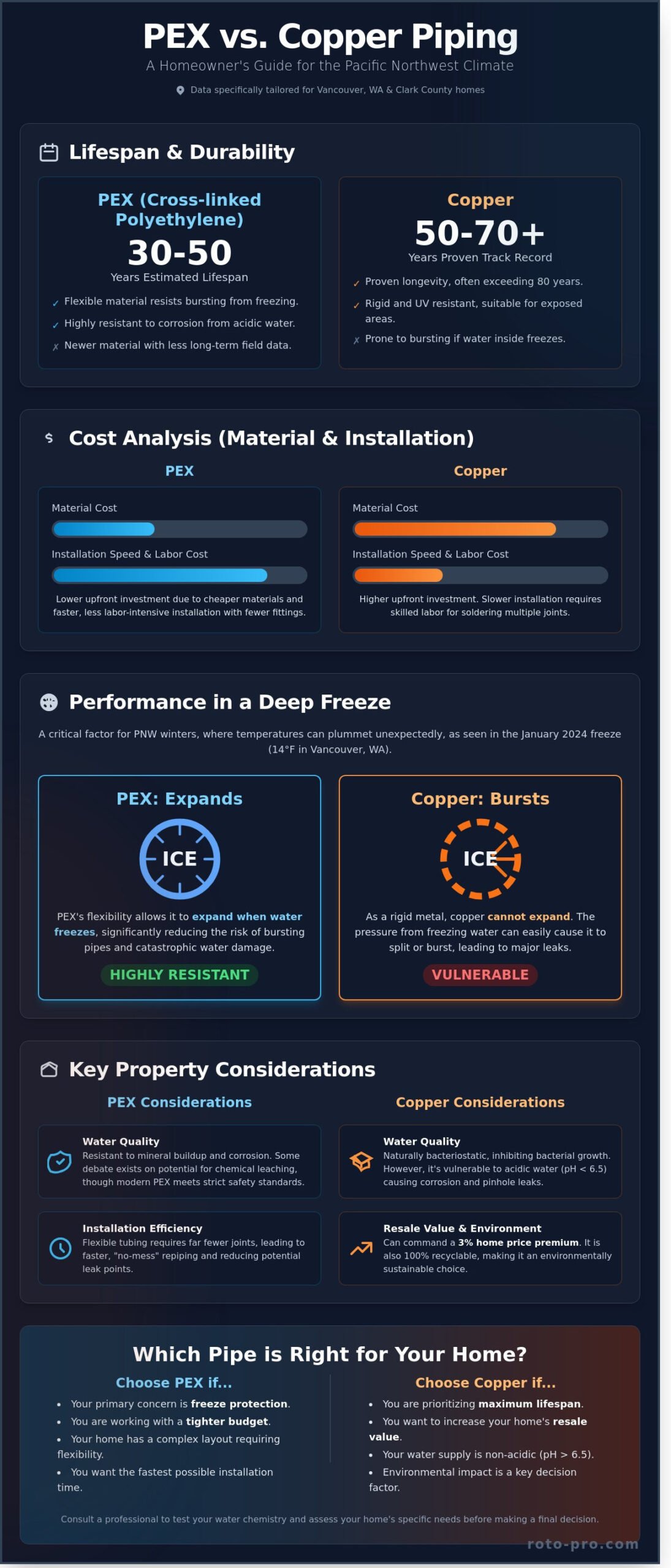
Homeowners in Clark County neighborhoods like Minnehaha and Rose Village are facing a critical infrastructure challenge. Since 2021, local requests for full-home repiping have increased by 40% as aging systems reach their natural failure point. Choosing between pex vs copper pipes isn’t just a technical decision; it’s a long term financial strategy for your property. Copper remains the traditional metallic gold standard, valued for its rigidity and documented 50 year track record in residential applications. In contrast, Cross-linked polyethylene (PEX) is a flexible, high-density plastic that has captured over 60% of the new construction market. The core conflict involves balancing the premium upfront investment of copper against the installation speed and corrosion resistance of PEX.
Why Material Choice Matters for Northwest Homes
In competitive markets like Camas and Vancouver, your choice of plumbing material directly impacts resale value. A 2023 real estate analysis showed that homes with updated copper systems can command a 3% price premium due to the perceived durability of metal. However, PEX is increasingly favored in the Pacific Northwest for its ability to expand during rare but damaging deep freeze events. Washington State insurance providers are also tightening their requirements; some carriers now apply a 10% surcharge on premiums for homes still utilizing legacy materials like galvanized steel. Local building codes, specifically the 2021 Washington State Plumbing Code, dictate strict support intervals and transition fittings that vary significantly between these two materials, making professional expertise essential for compliance.
The Evolution of Plumbing in Clark County
Vancouver’s plumbing history is a timeline of technical evolution and occasional failure. We’ve moved away from the corroding galvanized steel of the 1950s and the catastrophic failures of polybutylene, often called “Quest” pipe, which led to massive class-action settlements in the 1990s. Modern 2026 industry standards now prioritize materials that accommodate thermal expansion without stressing joints or causing pinhole leaks. The debate over pex vs copper pipes is often settled by the specific layout of the home, as PEX requires fewer fittings while copper offers unmatched structural integrity. PEX-a is manufactured using the Engel method for superior flexibility and thermal memory, while PEX-b is produced via the Silane method, offering higher burst pressure ratings at a more accessible price point.
Copper Piping: The ‘Forever’ Pipe for Southwest Washington
Copper has served as the backbone of Vancouver plumbing for over 80 years. It’s a material defined by longevity. Most copper systems are rated for 50 to 70 years of service, though many installations in historic Clark County homes have surpassed the 80-year mark without failure. This durability stems from the metal’s inherent strength and resistance to UV degradation. When weighing pex vs copper pipes for a full repipe, the initial investment in copper often yields the longest service life of any available material.
Beyond its lifespan, copper is naturally bacteriostatic. This means the metal surfaces actively inhibit the growth of bacteria, such as E. coli and Legionella, within your water supply. Environmental responsibility is another factor where copper excels. It’s a 100% recyclable material. When a home is repiped, the old copper is processed and reused rather than contributing to plastic waste in local landfills. When comparing PEX vs. Copper Piping according to Forbes, the higher upfront cost of copper is often balanced by its superior resale value and long-term reliability.
The Vulnerability to Local Water Chemistry
Local water chemistry plays a decisive role in copper’s performance. In parts of Clark County, particularly in homes served by private wells, acidic water with a pH below 6.5 can trigger pitting corrosion. This chemical reaction creates tiny pinhole leaks that are difficult to detect until they cause structural damage. Vancouver homeowners should look for blue-green staining on faucets or showerheads; this is a clear sign of copper corrosion. Because copper is rigid, it requires more joints and manual soldering. Every soldered elbow represents a potential fail point if the technician’s technique isn’t flawless.
Copper’s Performance During Washington Freezes
Rigid copper pipes face specific risks during Washington freezes. When temperatures drop to 20 degrees or lower, water inside the pipes expands. Because copper doesn’t flex, the internal pressure causes the pipe wall to rupture. Fixing these breaks requires specialized soldering skills and a perfectly dry environment, which makes 24/7 emergency repairs more expensive than PEX alternatives. For residential water lines, Type L copper is preferred over Type M because its thicker wall provides roughly 25% more material to withstand pressure and corrosion. If you suspect your lines are thinning, a professional inspection can identify risks before the next freeze arrives. Choosing the right thickness and ensuring proper insulation are the only ways to protect this rigid material from the physics of ice expansion.
PEX Piping: The Freeze-Resistant Modern Alternative
PEX, or cross-linked polyethylene, has transformed residential plumbing since its widespread adoption in the 1980s. When homeowners evaluate pex vs copper pipes, the primary advantage lies in physical flexibility. In older Camas homes built before 1970, rigid piping often requires extensive drywall demolition to navigate structural framing. PEX functions differently; it behaves like a high-pressure hose that technicians snake through existing wall cavities with minimal disruption to the home’s interior. This adaptability preserves the architectural integrity of historic properties while ensuring a modern delivery system.
The technical reliability of PEX stems from its “continuous run” capability. Traditional rigid systems require a fitting every time the pipe changes direction. Each joint represents a potential failure point. PEX utilizes long, seamless coils that stretch from a central manifold directly to a fixture. By eliminating intermediate connections, the risk of localized leaks drops by approximately 75%. From a financial perspective, choosing pex vs copper pipes typically saves homeowners 40% to 60% on total project costs. These savings result from lower raw material prices and a 30% reduction in labor hours, as installers don’t need to solder hundreds of individual joints.
Corrosion resistance is another critical factor for Pacific Northwest residents. Many local wells and municipal sources carry water with a pH level below 6.5, which is acidic enough to cause pinhole leaks in metal. PEX is chemically inert. It remains immune to the scale buildup and pitting that eventually destroy copper lines in high-acidity environments.
How PEX Handles the Pacific Northwest Chill
Thermal resilience is a vital consideration in Battle Ground and Brush Prairie, where winter temperatures frequently dip below freezing. PEX possesses a unique molecular memory that allows it to expand up to three times its original diameter without fracturing. While rigid pipes burst when ice forms, PEX expands to accommodate the pressure and returns to its original shape once thawed. We still insist on high-density foam insulation for pipes in unconditioned crawlspaces, but PEX provides a crucial safety margin that prevents catastrophic water damage during a cold snap.
Addressing the ‘Plastic’ Concerns
Vancouver residents often ask about material safety and durability. High-quality PEX-a, manufactured using the Engel method, undergoes a cross-linking process that eliminates the “plastic” taste sometimes associated with cheaper materials. Regarding pests, rodents don’t seek out PEX as a food source, though they may gnaw on any material blocking their path. We prevent this by sealing all entry points with steel wool and fire-stop sealants. It’s also vital to respect UV sensitivity; PEX degrades if exposed to direct sunlight for more than 30 to 60 days. Our technicians ensure every line is shielded from windows and never installed in exterior applications where UV rays could compromise the ASTM F876 structural standards.
The Direct Comparison: Performance in Vancouver’s Climate
Choosing between pex vs copper pipes requires a look at how these materials handle the specific environmental demands of the Pacific Northwest. In Vancouver, homeowners often prioritize a fast return to normalcy during a repipe. PEX installations typically finish 15% faster than copper projects because the material is flexible and requires fewer connections. This speed is vital for lived-in homes where families need their water service restored before the end of the workday. Understanding the full repipe timeline for a Vancouver home can help you plan around your family’s schedule and minimize disruption.
Heat retention remains a significant factor during cold Longview winters. PEX acts as a natural insulator, losing less heat as water travels from your tank to the faucet. Copper is a high-conductivity metal, which means it radiates heat into the surrounding air, forcing your water heater to work harder. Residents also notice a “quiet” factor with PEX. It absorbs the pressure waves that cause water hammer, whereas rigid copper pipes often vibrate or bang against wooden studs when a faucet shuts off abruptly.
The Roto Pro verdict depends on your specific property. For mid-century Vancouver ranch-style homes with tight crawlspaces, PEX is the superior choice for its maneuverability. For high-end custom builds where the homeowner wants a 50-year “legacy” material and doesn’t mind the 40% higher labor cost, copper remains a prestigious option.
Cost Breakdown: Upfront vs. Long-Term ROI
In the current Clark County market, copper piping costs between $12 and $18 per linear foot for materials and labor. PEX is significantly more accessible, ranging from $3 to $6 per linear foot. This price gap has widened due to a 22% decrease in available journeyman plumbers in Washington state who specialize in skilled soldering. As labor becomes scarcer, the cost of installing copper continues to climb. PEX also wins on long-term maintenance; it’s immune to the “pitting” corrosion caused by the slightly acidic water sometimes found in local well systems, which can lead to expensive pinhole leak repairs in copper after 15 years. Homeowners planning a full system upgrade can find a detailed breakdown of the process and costs in our whole house repiping guide for Vancouver, WA.
Freeze-Burst Resistance: A Side-by-Side Analysis
When temperatures in Vancouver drop to 15 degrees Fahrenheit, the water inside your pipes expands by approximately 9% in volume. Copper is a rigid material with zero elasticity; if the water freezes, the pipe will likely split or the soldered joints will fail. PEX-a piping features “thermal memory,” which is a physical property that allows the pipe to expand up to three times its original diameter and then shrink back to its initial size once the ice thaws.
- Pressure Protection: We install pressure-reducing valves (PRVs) set to 60 PSI to prevent stress on PEX joints.
- Expansion Tanks: These are mandatory in Clark County for closed-loop systems to absorb thermal expansion.
- Failure Points: Copper usually bursts at the midpoint of a run, while PEX remains intact.
If you’re worried about how your current plumbing will handle the next freeze, you can schedule a professional repipe assessment with our team to evaluate your home’s vulnerability.
The Roto Pro Approach to Repiping in Vancouver, WA
Roto Pro approaches every Vancouver home with technical precision and professional humility. As licensed general contractors, we don’t just swap pipes; we manage the entire structural environment of your plumbing system. Our team prioritizes a “no-mess” protocol during every project. This involves using heavy-duty floor protection and making surgical wall openings to minimize dust and debris. We understand that your home is a sanctuary, so we treat it with the respect it deserves while performing complex mechanical upgrades.
Safety and compliance are non-negotiable. Every repiping project we undertake meets or exceeds the 2021 Washington State Plumbing Code and specific Clark County building ordinances. We handle the permitting process and coordinate with local inspectors to ensure your new system is fully documented and legal. Our 24/7 emergency support provides long-term security, offering immediate assistance for both PEX and copper systems if an unexpected issue arises. For main water line replacements, our excavation team manages the heavy site work. We use specialized equipment to replace exterior lines with minimal disruption to your landscape or driveway.
Having the right tools and equipment is crucial for any large-scale home project, and that includes the service vehicles that transport them. For professionals in the trades, a well-organized truck is essential for efficiency. If you’re curious about how these commercial vehicles are customized for demanding jobs like plumbing and excavation, you can check out Tim Halpin Equipment Corp for examples of expert upfitting.
Custom Material Recommendations for Your Property
Property needs vary, so we rarely apply a one-size-fits-all solution. In many cases, we recommend a hybrid system. This utilizes copper for visible lines near water heaters or under-sink connections for maximum durability, while using PEX for hidden runs through wall cavities to reduce costs. Before we weigh the benefits of pex vs copper pipes for your home, we test your local water quality. We look for specific pH levels and mineral content that could lead to premature corrosion. Our excavation expertise is vital for exterior utility line transitions, ensuring the connection between municipal supply and your home remains watertight for decades. If you’re experiencing unusual water pressure issues, discoloration, or metallic odors, these could be signs of failing pipes that require immediate attention before considering a full repipe.
While testing water quality for its impact on pipes is important, ensuring it’s also free from modern contaminants is crucial for your family’s health. For homeowners looking to remove substances like PFAS, microplastics, and heavy metals, a whole-home system from a specialist like Tradewinds Water Filtration is the most effective solution.
Ready for a Safer Home? Next Steps
Taking the next step toward a reliable plumbing system is straightforward. You can schedule a comprehensive plumbing audit in Vancouver or Battle Ground to identify hidden leaks or aging galvanized steel. During a Roto Pro repiping consultation, you can expect a transparent experience. We provide a fixed-price estimate and a logical project timeline without any high-pressure sales tactics. We focus on the technical reality of your pipes and offer solutions that guarantee long-term comfort. For a complete overview of what the process involves from start to finish, our 2026 whole house repiping guide for Vancouver homeowners walks you through every stage of the project.
- Detailed Assessment: We inspect every fixture and connection point.
- Customized Planning: We design a layout that optimizes water pressure.
- Professional Execution: Our experts handle everything from the initial shut-off to the final pressure test.
Contact Roto Pro for a professional repiping estimate in Vancouver to ensure your home’s water system is built to last.
Secure Your Home’s Plumbing Future
Choosing between pex vs copper pipes involves balancing immediate installation costs with 50-year durability. Copper provides a rigid, time-tested solution that resists bacterial growth; however, PEX offers 300% expansion capacity to prevent cracks during freezing Vancouver winters. Roto Pro delivers specialized expertise in both materials, ensuring every fitting meets factory-grade standards. We operate as a fully licensed, bonded, and insured contractor in Washington State, providing 24/7 emergency response for urgent failures. Our technicians manage the entire scope of work, from 8-foot deep main line excavations to complex interior repiping. We don’t rely on guesswork. Instead, we apply rigorous technical logic to restore your home’s safety and water pressure.
You deserve a plumbing system that functions silently and reliably for decades. Our team respects your time and your property, maintaining a clean workspace from start to finish. We’re ready to provide the stability your Southwest Washington home requires.
Schedule your professional repiping consultation with Roto Pro today!
Frequently Asked Questions
Is PEX as good as copper for residential plumbing in Washington?
PEX is an excellent choice for Washington homes because it handles the region’s acidic water better than traditional metal. Copper often develops pinhole leaks in areas with low pH levels, which are common in Pacific Northwest well water systems. PEX remains chemically inert and resists this specific type of corrosion. It’s a reliable, professional grade solution that provides long term security for your home’s infrastructure and prevents unexpected water damage.
Can PEX pipes freeze and burst in Vancouver winters?
PEX is significantly more freeze resistant than copper because it can expand up to 3 times its original diameter without rupturing. While copper pipes burst at 3,000 PSI when water freezes inside them, PEX absorbs the expansion pressure. You still need to insulate pipes in unheated crawlspaces to prevent ice blockages. Proper installation ensures your plumbing remains functional during sub-freezing Vancouver cold snaps that typically reach 20 degrees Fahrenheit.
How much does it cost to repipe a house with PEX vs copper in Clark County?
A standard 2,000 square foot home in Clark County typically costs between $4,500 and $8,000 for PEX, while copper ranges from $10,000 to $15,000. When comparing pex vs copper pipes, PEX requires 40 percent less labor because it uses fewer fittings and flexible runs. These savings allow homeowners to invest in higher quality fixtures or professional grade manifolds while staying within their renovation budget. Professional installers complete PEX projects in roughly 2 days, and you can learn more about what to expect by reviewing the typical repipe timeline for Clark County homes.
Does PEX piping affect the resale value of my Vancouver home?
PEX maintains your home’s resale value by providing a modern, leak free system that appraisers recognize as a standard upgrade. Most buyers in the Vancouver market prioritize a reliable plumbing system over specific material types. A professionally installed PEX system eliminates the risk of pinhole leaks associated with older copper. This stability provides peace of mind to potential buyers during a home inspection and ensures the plumbing meets current building codes.
Why is copper still used if PEX is cheaper and freeze-resistant?
Copper remains the preferred material for outdoor exposures because PEX degrades within 30 to 60 days of direct UV light exposure. It also offers natural antimicrobial properties that prevent bacterial growth in the water line. Some high end custom builds still utilize copper for its 50 year track record and rigidity. We use copper specifically for water heater connections and exterior hose bibs to ensure the system meets factory specifications for durability.
What is the lifespan of PEX compared to copper?
PEX has a projected lifespan of 40 to 50 years, whereas copper can last 50 to 70 years under ideal conditions. However, in regions with acidic soil or water, copper’s lifespan often drops below 25 years due to pitting corrosion. PEX provides a more consistent performance in the Pacific Northwest environment. Choosing the right material depends on your specific water chemistry and the long term goals for your property’s maintenance.
Do rodents eat through PEX pipes in Pacific Northwest crawlspaces?
Rodents can chew through PEX, but they don’t seek it out as a food source. Data suggests that 95 percent of rodent damage occurs when pipes block a pest’s established path or when they’re looking for water. We recommend sealing all entry points in your crawlspace with steel wool or hardware cloth. Professional installation includes securing pipes away from common pest routes to minimize this risk and ensure the long term integrity of the system.
Is PEX-a better than PEX-b for whole-house repiping?
PEX-a is the superior choice for a full repipe because it offers 100 percent cross linking and thermal memory. If PEX-a gets kinked during installation, a technician can repair it with a heat gun, which is impossible with PEX-b. When evaluating pex vs copper pipes, PEX-a provides the most flexible and durable alternative. It uses expansion fittings that don’t restrict water flow like the smaller crimp fittings used in PEX-b systems.