On August 12, 2024, a homeowner in Camas watched a routine backyard project transform into a high-stakes emergency after an excavator blade severed an unmarked secondary power line. It’s a stressful reality that many residents face when they underestimate the precision required for underground work. When you’re planning utility trenching clark county projects, the difference between a successful installation and a costly utility strike is often measured in just a few inches of soil.
You likely worry that hitting a hidden gas or water line will cause permanent property damage or result in expensive repair fees. It’s natural to feel overwhelmed by the conflicting permit requirements between the City of Vancouver and Clark County’s building departments. This 2026 guide provides the exact technical specifications, depth requirements, and local codes you need to ensure your project meets professional standards. We will examine the specific steps for securing permits and the safety protocols that professional contractors use to keep your home and family safe.
Key Takeaways
- Understand how local geography dictates the precision excavation needed for stable underground infrastructure in SW Washington.
- Master the essential legal standards for utility trenching clark county, including specific depth requirements and the “Three-Foot Rule” for line separation.
- Protect your property by learning how to mitigate the risks of the Pacific Northwest wet season and prevent costly trench settling.
- Follow a structured, step-by-step excavation process that prioritizes safety through 811 compliance and site potholing.
- Learn the advantages of professional site work that balances technical plumbing requirements with clean, non-disruptive landscape practices.
The Fundamentals of Utility Trenching in Clark County, WA
Utility trenching serves as the critical first step in establishing a property’s lifeline. It’s the precision excavation required to house underground infrastructure like water mains, electrical conduits, and fiber optic cables. In the Pacific Northwest, utility trenching clark county demands a deep understanding of local soil mechanics and strict adherence to Washington State’s evolving 2026 building codes. Professional site work ensures that these subterranean systems remain protected from shifting earth and environmental degradation for decades.
Why Local Geography Matters
Residential vs. Commercial Trenching Needs
The scope of work differs based on the project’s density and intended use. Residential service lines typically connect a single home to a municipal main, but the rise of Accessory Dwelling Units (ADUs) in Vancouver has added complexity. Recent 2024 zoning updates have led to a 22% increase in ADU applications, often requiring dual-utility runs in confined backyard spaces. Commercial projects, such as new developments in Camas, involve much larger scales. These sites require:
- Strict vertical and horizontal separation between power and water lines to prevent thermal interference.
- Deep-trench municipal main connections that handle higher volume flows.
- Precision grading to ensure gravity-fed sewer systems function without mechanical pumps.
Properly executed utility trenching clark county ensures that every pipe and wire remains accessible for future maintenance while meeting the rigorous standards set by Clark Public Utilities and local municipal codes. Skipping professional site preparation often leads to utility strikes or premature pipe failure, which costs homeowners significantly more in emergency repairs.
Navigating Clark County Codes: Depth, Bedding, and Separation
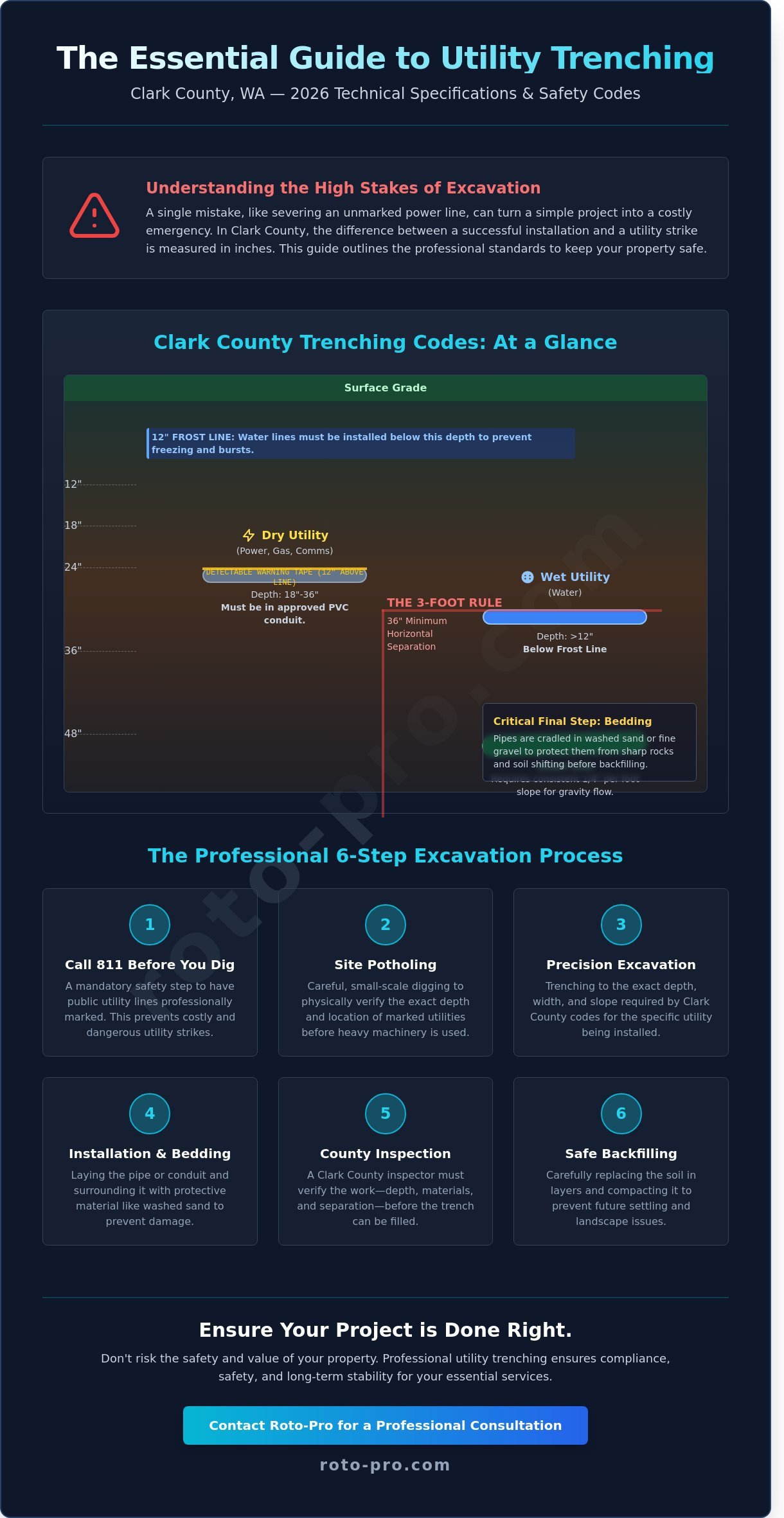
Compliance with local building codes ensures the long-term safety of your home’s infrastructure. For projects involving utility trenching clark county, standard depth requirements typically range from 18 to 36 inches depending on the specific service. These depths protect lines from heavy vehicle traffic and soil movement. All work must align with Washington State excavation regulations to prevent trench collapse and ensure worker safety during the installation phase.
Wet Utilities: Water, Sewer, and Stormwater
Precision is mandatory for wet utilities. Sewer lines must maintain a consistent slope, usually 1/4 inch per foot for 4-inch pipes, to facilitate reliable gravity flow. Southwest Washington water lines are installed deeper than the 12-inch frost line to prevent pipe bursts during freezing weather. We strictly follow the Three-Foot Rule. This standard requires 36 inches of horizontal separation between water and sewer lines to prevent contamination. If an older system fails these standards, professional sewer line repair clark county experts can bring the property back into compliance.
Dry Utilities: Power, Gas, and Communications
Dry utility installation involves rigid conduit requirements. Electrical lines must be encased in approved PVC conduit to meet Clark Public Utilities (CPU) standards. Coordination with CPU is essential before the first shovel hits the ground. To prevent future utility strikes, we place detectable warning tape 12 inches above the buried lines. This simple precaution provides a physical warning for any future excavation work on the property. Proper utility trenching clark county depends on these small but vital safety measures.
The final step before backfilling is the bedding process. We use washed sand or fine gravel to cradle the pipes, protecting them from sharp rocks and soil shifting. Clark County inspectors must verify the trench depth, bedding material, and pipe integrity during a scheduled site visit before any dirt is replaced. If you have questions about your specific site plan, the team at Roto-Pro provides the technical guidance needed for a successful inspection and long-term system stability.
The High Cost of Shallow Trenches: Common SW Washington Pitfalls
Cutting corners on depth is a gamble that rarely pays off in Southwest Washington. A trench dug just a few inches too shallow might seem like a time-saver, but it often leads to a failed inspection. In Clark County, inspectors adhere strictly to the Clark County Public Works Standard Details to ensure long-term infrastructure stability. Failing an inspection doesn’t just stall your project; it requires re-digging and rescheduling specialized crews, which can add hundreds of dollars in avoidable labor costs and permit fees.
Impact of Rain on Unstable Trenches
The Pacific Northwest wet season transforms local soil into a heavy, semi-liquid mass. This saturation increases lateral pressure against underground pipes, which causes structural deformation if the trench isn’t properly backfilled. Without precise compaction, water pools in the loose soil around the utility line, creating “soft spots” that eventually lead to sinkholes or cracked conduits. Vancouver’s annual rainfall average of 42 inches makes it essential to synchronize utility trenching clark county schedules with dry weather windows to ensure soil integrity during the backfill process.
Root Intrusion and Utility Protection
Clark County’s landscape, dominated by Douglas Firs and Bigleaf Maples, presents a constant threat to underground lines. These species have aggressive root systems that seek out the moisture and warmth found in sewer pipes. A tiny hairline fracture is enough for a root tip to enter; once inside, it expands rapidly and causes total blockages. Professional hydro jetting vancouver wa services provide a critical maintenance solution to clear these obstructions, but prevention is more cost-effective. When planning utility trenching clark county, we use the following strategies:
- Physical Barriers: Installing root shields in areas with high-density foliage.
- Strategic Setbacks: Keeping utilities at least 10 feet away from the future canopy growth of young trees.
- Depth Precision: Digging below the primary root zone of local shrubs to minimize contact.
Precision in the digging phase ensures that your home’s infrastructure remains stable despite the challenging environmental factors of the Pacific Northwest. Proper depth isn’t just a code requirement; it’s a safeguard against the natural shifts of the local landscape. For homeowners facing existing sewer line failures caused by root intrusion, trenchless sewer repair vancouver wa offers a modern solution that preserves your landscaping while restoring full functionality to your underground systems. Homeowners dealing with more severe pipe damage should also review their options for expert sewer line repair in Clark County to understand the full range of code-compliant solutions available in 2026.
The Step-by-Step Excavation Process for New Utilities
A professional utility installation follows a strict sequence to ensure safety, legal compliance, and structural longevity. It begins with precise planning and ends with a stable, compacted surface that prevents future ground sinking. Every phase of utility trenching clark county requires technical precision to protect your property and the surrounding infrastructure.
Permitting and Washington 811
Washington State law requires every homeowner and contractor to contact the Utilities Underground Location Center at least two business days before breaking ground. This is non-negotiable. By calling 811, you trigger a process where public utility providers mark the location of gas, water, and power lines with color-coded paint.
In the City of Vancouver, permit reviews for utility work typically take 10 to 14 business days. Unincorporated areas of Clark County may have different timelines depending on the complexity of the site. Digging without a valid 811 ticket is a major liability. If a line is damaged during a DIY project, the homeowner is often held responsible for repair costs and state fines that can reach thousands of dollars.
Excavation, Bedding, and Compaction
Once the site is marked, the physical work begins with “potholing” or hydro-excavation. This process uses pressurized water to safely expose existing underground lines, which eliminates the risk of a backhoe bucket striking a hidden pipe. After the trench reaches the depth required by local code, the focus shifts to the foundation of the line.
- Bedding: We install a 4-inch layer of sand or 5/8-minus crushed rock. This protects the pipe from sharp stones found in native soil.
- Testing: Every line is inspected or pressure tested before we move any dirt back into place.
- Backfilling: We don’t simply push the original dirt back into the hole. Native soil in Clark County often has high clay content, which settles unevenly.
- Compaction: Soil is replaced in 6-inch “lifts,” with each layer mechanically compacted to ensure the ground remains level for decades.
Professional Site Work: Why Roto Pro is Clark County’s Trenching Expert
Choosing a contractor for utility trenching clark county requires more than just finding someone with a backhoe. Roto Pro brings a unique perspective to every project by combining master-level plumbing knowledge with heavy excavation capabilities. We don’t view a trench as a simple hole in the dirt. It’s a precision-engineered channel designed to protect your home’s most vital infrastructure for decades. Our dual expertise ensures that every slope and bedding layer meets exact technical specifications before a single pipe is laid.
Combining Plumbing Expertise with Heavy Excavation
Serving Vancouver, Camas, and Beyond
Securing Your Property’s Infrastructure for 2026 and Beyond
Successful utility trenching clark county requires more than just moving dirt; it demands strict adherence to Washington State’s WAC 296-155-657 safety standards and Clark County’s specific depth requirements for water, power, and gas lines. Skipping the precision of proper bedding or ignoring separation codes often leads to structural failures or utility damage within the first five years of installation. Roto Pro has operated as a locally owned and operated business since 2019, bridging the gap between heavy excavation and precision plumbing expertise. As a licensed General Contractor in Washington State, we ensure every trench meets the 2026 technical specifications for stability and long term performance. You shouldn’t settle for “good enough” when it comes to the underground systems that power your home. Our team provides the technical accuracy needed to protect your property investment from the start. We’re ready to bring professional grade stability to your next project.
Get a Professional Excavation Estimate for Your Clark County Property
Your property deserves a foundation built on expertise and reliability. We look forward to helping you build a safer, more efficient home environment.
Frequently Asked Questions
How deep should a utility trench be in Clark County?
In Clark County, most water and electrical lines require a minimum depth of 18 to 24 inches to meet local safety standards. Specifically, the Washington State Department of Labor and Industries mandates that electrical conduit sit at least 18 inches below the surface in residential areas. Sewer lines often require deeper excavation to maintain a 2 percent slope for proper gravity drainage. Professional installation ensures these depths are consistent to prevent freezing or accidental damage during future landscaping.
Do I need a permit for utility trenching on my own property in Vancouver, WA?
You must obtain a permit for utility trenching through Clark County Community Development or the City of Vancouver Public Works department. Any excavation deeper than 12 inches or work that connects to municipal systems requires official oversight and an inspection. Skipping this step leads to legal fines and creates complications when you try to sell your home later. Our team handles the technical documentation to ensure your project aligns with the 2026 regional building codes.
How much does utility trenching cost per foot in Clark County?
National industry data for 2024 shows that utility trenching clark county costs typically range from $5 to $15 per linear foot for excavation labor. These rates vary based on soil conditions, as the heavy clay and basalt rock found in Southwest Washington often require specialized machinery. Total project costs will rise when you include materials like PVC conduit, bedding sand, and specific backfill layers. We provide a clear, logical breakdown of these technical requirements to ensure budget stability.
Can I put multiple utilities in the same trench?
You can place multiple utilities in a single trench using a method known as joint trenching. This strategy is efficient but requires strict adherence to vertical and horizontal separation rules to prevent interference. For instance, gas and electrical lines generally need a 12-inch gap between them to ensure safety. Using high quality warning tapes and proper bedding materials for each service is a standard part of our professional process to guarantee long term reliability.
What happens if I hit a utility line while digging without a permit?
Hitting an underground line without a permit or a valid 811 locate request results in immediate safety hazards and heavy financial liability. Under Washington law RCW 19.122.070, you’re responsible for all repair costs and may face civil penalties of $1,000 or more per incident. Beyond the financial impact, a severed gas or power line puts your entire neighborhood at risk. Professional excavators always confirm utility marks before the bucket enters the soil to maintain a safe environment.
How far should a trench be from my property line or house foundation?
The ideal window for utility trenching clark county is between May and September when the ground is driest. Clark County receives an average of 42 inches of rain annually, and digging in saturated winter soil often leads to trench wall collapses and significant site mess. By scheduling work during the drier months, we ensure a cleaner workspace and better soil compaction during the backfilling process. This timing leads to a more stable and professional finish for your property.
How long does a typical residential trenching project take?
A standard residential project covering 50 to 100 feet usually takes 1 to 2 business days to complete from start to finish. This timeframe includes the initial site preparation, the actual excavation, and the final backfilling once the pipes or conduits are set. Projects involving extremely rocky terrain or those requiring multiple municipal inspections might take 3 days. We focus on a structured, efficient workflow to minimize the time your yard is disrupted and ensure the job is done right.