On a cold Tuesday morning in Clark County, the third person in your household shouldn’t have to settle for a lukewarm shower because a bulky tank ran out of capacity. You likely recognize that traditional water heaters are both space-intensive and inefficient, often consuming 18% of a typical home’s energy budget according to the U.S. Department of Energy. When considering a tankless water heater vancouver wa residents often look for a solution that balances immediate comfort with long-term mechanical reliability. We understand that a water heater isn’t just an appliance; it’s a critical component of your home’s infrastructure that requires a precise, code-compliant approach.
This guide examines whether this upgrade fits your specific household needs and architectural constraints. We’ll detail local installation standards, precise sizing for Pacific Northwest groundwater temperatures, and the maintenance protocols required to ensure your system reaches its intended 20 year service life. By the end of this article, you’ll have the technical clarity needed to decide if endless hot water and lower monthly utility bills are the right investment for your property.
Key Takeaways
- Evaluate how on-demand heating eliminates standby heat loss to significantly improve energy efficiency during cold Pacific Northwest winters.
- Calculate your home’s specific Gallons Per Minute (GPM) needs to select the correctly sized tankless water heater vancouver wa for your household.
- Compare the long-term viability of gas versus electric fuel sources based on the utility infrastructure of your Clark County neighborhood.
- Identify the critical Washington building codes and venting requirements that must be met to ensure a safe, legal, and high-performance installation.
- Understand why professional maintenance and expert installation are necessary to protect your manufacturer warranty and maximize the system’s lifespan.
Tankless vs. Traditional Water Heaters: The Vancouver Comparison
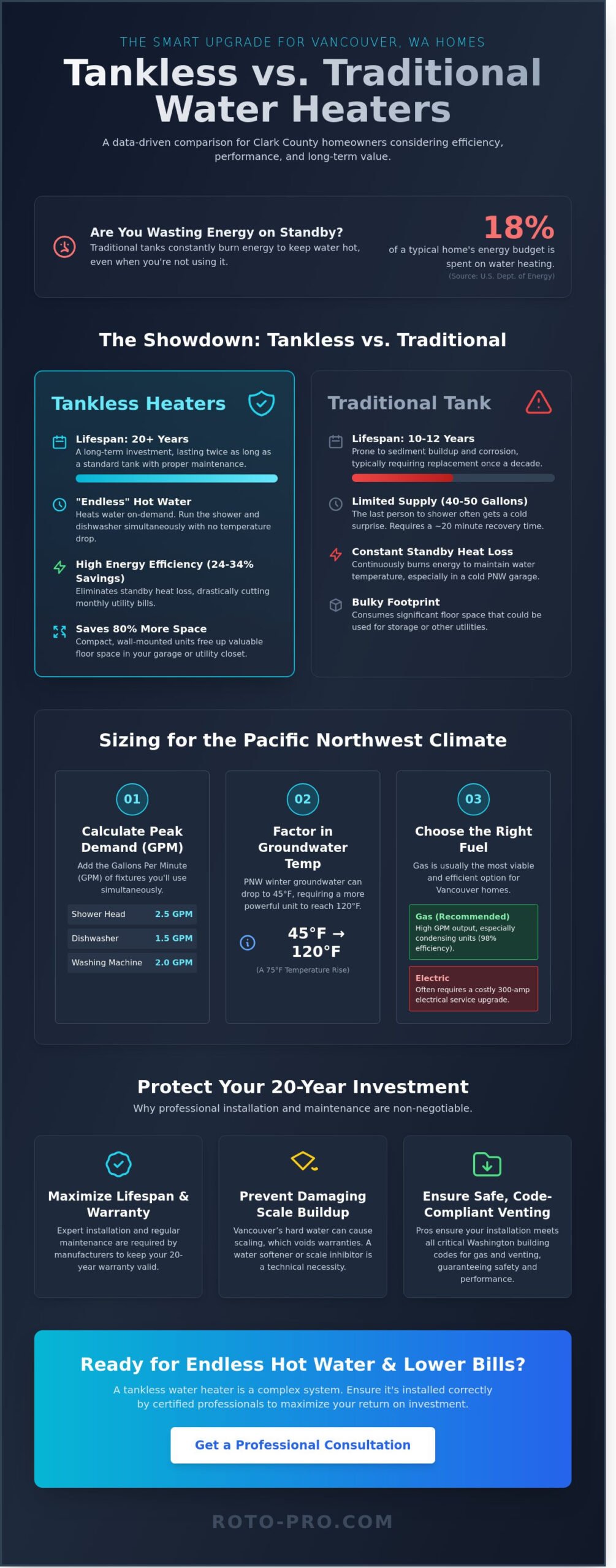
Traditional water heaters maintain 40 to 50 gallons of water at a constant temperature throughout the day. This process creates constant standby heat loss. During Pacific Northwest winters, where outdoor temperatures often hover between 34°F and 42°F, your tank works harder to combat the cold air in a garage or crawlspace. A tankless water heater vancouver wa eliminates this inefficiency by heating water only when a faucet opens. Understanding how tankless water heaters work involves looking at high-powered burners or electric elements that activate instantly to meet demand.
In modern Camas developments or compact Downtown Vancouver homes, floor space is a priority. A tankless unit occupies roughly 80% less space than a standard tank. It’s a wall-mounted solution that frees up square footage for storage or other utilities. While the upfront equipment cost is higher, a tankless water heater vancouver wa provides a superior long-term ROI. These systems offer a 20 year service life when maintained with professional precision. Standard tanks usually fail after 10 or 12 years due to inevitable sediment buildup and internal corrosion. You’re essentially investing in one unit instead of two over a two-decade period.
The “Endless Hot Water” Factor for Large Families
Large households often face a 20 minute wait between showers to allow a tank to recover. Tankless technology provides a continuous flow. You can operate a high-efficiency dishwasher and a master shower simultaneously without a drop in temperature. This reliability stems from precise flow sensors and modulating gas valves. It ensures that the last person in the shower receives the same comfort as the first, regardless of the time of day.
Energy Efficiency and Washington Utility Rebates
Switching to a tankless system reduces energy consumption by approximately 24% to 34% for homes using 41 gallons of hot water or less daily. Clark Public Utilities and NW Natural frequently provide financial incentives or rebates for high-efficiency upgrades. These programs encourage homeowners to replace aging, inefficient infrastructure with factory-standard technology. A professional installation ensures your system meets the specific technical criteria required to qualify for these local Washington savings, combining monthly utility reduction with immediate financial incentives.
Choosing the Right Tankless System for Your Clark County Home
Selecting a tankless water heater vancouver wa requires a precise calculation of peak demand rather than a simple tank capacity estimate. You must determine your home’s total flow rate by adding the Gallons Per Minute (GPM) of every fixture likely to run simultaneously. A standard shower head uses 2.5 GPM, while a high-efficiency dishwasher requires 1.5 GPM. In the Pacific Northwest, groundwater temperatures often drop to 45°F during winter months. This significant temperature gap means your system must work harder to reach a standard 120°F output, effectively lowering the GPM capacity of smaller units.
The U.S. Department of Energy highlights that energy savings are highest when units are sized correctly for these local climate variables. Gas-fired units are generally the most viable choice for Vancouver households. Electric models often require a 300-amp electrical service upgrade, which adds complexity to the installation. We typically recommend condensing units for their 98% thermal efficiency. While they require a dedicated drain line for acidic condensate, their long-term performance outweighs the simpler but less efficient 80% rating of non-condensing models.
The Critical Role of Water Quality and Scaling
Vancouver’s water contains mineral content that can crystallize within the narrow passages of a heat exchanger. This process, known as scaling, restricts water flow and forces the unit to overheat. If left unmanaged, scale buildup can void a manufacturer warranty in as little as 24 months. Integrating a scale inhibitor or a water softening system is a technical necessity to protect your investment. These additions ensure the 20-year projected lifespan of your tankless water heater vancouver wa remains achievable.
Addressing the “Cold Water Sandwich” and Recirculation
Standard tankless units can occasionally deliver a brief burst of cold water when multiple taps are cycled rapidly. To solve this, we install units equipped with internal recirculation pumps. These pumps maintain a constant loop of hot water in the plumbing lines, providing nearly instant heat at the faucet. If you want to ensure your system provides consistent comfort, a professional evaluation of your home’s pipe routing is the most reliable first step.
Professional Installation and Maintenance with Roto Pro
Installing a tankless water heater vancouver wa requires technical precision that goes beyond basic plumbing. Most major manufacturers explicitly state that DIY installations void the 12-year heat exchanger warranty. Roto Pro ensures your investment remains protected by adhering to every factory specification. Our team manages the entire permit process required by Clark County, ensuring your system meets strict Washington State building codes. We focus heavily on gas line sizing. While standard tanks often use 1/2-inch lines, high-efficiency tankless units typically require 3/4-inch upgrades to handle the 199,000 BTU demand. Professional calibration is what makes these systems worth the investment for local homeowners looking for long-term reliability.
The Roto Pro “Clean Work” promise means we treat your home with absolute respect. We use protective floor coverings and perform precision pipe fitting to ensure a compact, leak-proof setup that saves space. Beyond the initial setup, we emphasize the importance of annual maintenance. Vancouver’s water can contain minerals that cause scale buildup. A 60-minute professional flush every 12 months prevents efficiency loss and protects the copper or stainless steel heat exchanger from premature failure. It’s the simplest way to double the lifespan of your unit.
Venting Requirements for Vancouver Homes
Modern units require specialized venting to handle acidic condensate and high exhaust temperatures. We help you choose between direct vent systems, which use two pipes to pull and push air, or power vent systems for tighter spaces. Retrofitting older homes in Battle Ground or Kelso often involves creative routing through exterior walls or existing chimney chases. We ensure every vent terminates at least 12 inches above the local snow line to prevent unexpected winter shutdowns.
Total Home Plumbing Health
A high-flow tankless system can deliver over 5 gallons of water per minute continuously. Your drainage system must be ready for this consistent volume. For homes built before 1995, we often recommend a hydro jetting vancouver wa session during the upgrade. This clears decades of scale and debris from your main lines, ensuring your new tankless water heater vancouver wa doesn’t overwhelm older pipes. If any issues arise after the project, our 24/7 emergency support provides the stability your family needs.
Secure Your Home’s Future with Modern Efficiency
Switching to a tankless system offers more than just endless hot water. The U.S. Department of Energy reports that high-efficiency units can be 34% more energy efficient than traditional tanks in homes with moderate water usage. This upgrade reduces your monthly utility footprint while freeing up square footage in your Clark County home. It’s a practical step toward a more sustainable and comfortable household environment.
Precision matters when dealing with complex gas lines and venting requirements. Roto Pro operates as a fully licensed, bonded, and insured WA contractor with specialized expertise in heavy excavation and utility work. We don’t just swap units; we ensure your infrastructure supports a tankless water heater vancouver wa for the long term. Our team provides 24/7 emergency plumbing support across Clark County, so you’re never left without professional assistance when it matters most.
Schedule your Vancouver tankless water heater consultation with Roto Pro today. Taking this step ensures your home benefits from professional-grade reliability and consistent comfort for years to come.
Frequently Asked Questions
How much does it cost to install a tankless water heater in Vancouver, WA?
The total investment for a tankless water heater vancouver wa installation depends on the unit’s flow rate and your home’s existing infrastructure. National industry reports from 2024 indicate that homeowners typically invest between $2,500 and $4,500 for a professional retrofit. This figure includes the high-efficiency unit, specialized venting materials, and the technical labor required to meet Clark County building codes.
Will a tankless water heater work during a power outage in Clark County?
Your tankless system won’t function during a power outage because the electronic ignition and safety sensors require a constant electrical supply. Even though the primary fuel source is natural gas or propane, the unit’s motherboard cannot trigger the heating cycle without 120-volt power. Homeowners can resolve this by installing a dedicated battery backup system, which provides enough power for approximately 50 to 100 shower cycles during a local grid failure.
How long does a professional tankless installation take?
A standard professional installation of a tankless water heater vancouver wa usually takes between 6 and 10 hours of focused labor. This duration covers the removal of your decommissioned tank, the mounting of the new wall-hung unit, and the precision calibration of the gas-to-air ratio. If your project involves rerouting water lines or installing a new concentric venting system through an exterior wall, our team provides a specific timeline during the initial site inspection.
Do I need to upgrade my gas line for a tankless water heater?
You’ll likely need to upgrade your gas line because tankless models require a significantly higher BTU input than traditional storage tanks. A standard tank uses roughly 40,000 BTUs, whereas a whole-home tankless unit can demand up to 199,000 BTUs to heat water instantly. Upgrading to a 0.75-inch or 1-inch gas line ensures the unit receives adequate fuel pressure when multiple hot water taps run simultaneously.