On a 28-degree morning in Vancouver, Washington, a family of four can easily exhaust a standard 40-gallon tank before the second person even finishes their shower. Most homeowners realize that improper water heater sizing is the primary reason for these icy surprises and the resulting spike in monthly utility bills. You shouldn’t have to guess whether your equipment can handle a Clark County winter when technical data provides a definitive answer.
We believe that professional precision is the only way to guarantee long-term home comfort and system reliability. This guide provides the exact formulas used by experts to calculate the capacity your household requires for 2026 and beyond. You’ll learn how to determine the first-hour rating for traditional tanks and the precise gallons-per-minute needed for tankless systems based on local groundwater temperatures. By applying these industry standards, you can secure a consistent supply of hot water while maintaining the highest level of energy efficiency in your home. This approach ensures your new unit meets peak demand without the waste of an oversized system.
Key Takeaways
- Understand why First Hour Rating (FHR) is a more critical performance metric than simple tank capacity for ensuring a steady hot water supply.
- Learn how to accurately calculate water heater sizing by evaluating your household’s peak demand and the specific flow rates of your fixtures.
- Discover how to estimate GPM requirements to determine if a high-efficiency tankless system can handle your home’s simultaneous hot water needs.
- Identify essential professional factors for Clark County, including Washington State seismic strapping codes and the role of thermal expansion tanks.
- Gain the technical insight needed to select a system that guarantees long-term comfort and reliability during the coldest Vancouver winters.
The Science of Sizing: Understanding Peak Demand and First Hour Rating
Selecting a new unit involves more than just picking a tank that fits in your garage. Accurate water heater sizing requires a technical understanding of how your home consumes energy during its busiest moments. Most homeowners focus solely on the nominal tank capacity, such as a 50-gallon or 80-gallon model. However, this number only represents the storage volume, not the actual delivery capability of the system.
The industry standard for measuring performance is the First Hour Rating (FHR). FHR is the number of gallons a heater can supply in its first hour of operation starting with a full tank. This metric accounts for both the stored hot water and the unit’s ability to heat new water as it enters the storage water heater. If your current system leaves you with cold showers by 7:15 AM, the FHR likely doesn’t match your household’s peak demand.
Why FHR Matters More Than Tank Volume
A high-volume tank with a low recovery rate will struggle during back-to-back usage. Recovery rate refers to the unit’s ability to replenish hot water after the initial storage is depleted. This performance depends heavily on the BTU input of gas burners or the wattage of electric elements. Professional water heater sizing ensures these technical specs align with your lifestyle. If you notice a sudden drop in performance despite having a large tank, you may need a water heater repair Vancouver WA to address failing heating elements or sediment buildup that restricts heat transfer.
Calculating Your Household Peak Demand
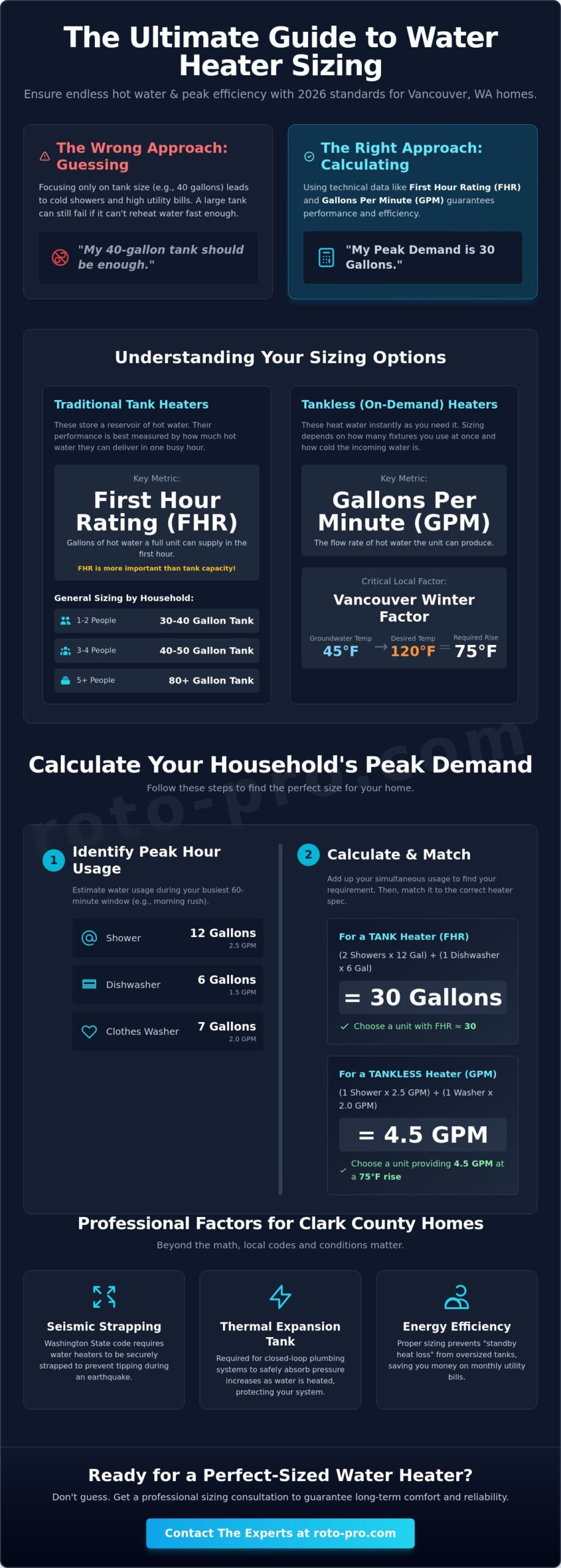
To find the right fit, you must identify your busiest 60-minute window. For most Vancouver families, this occurs during the morning rush. You can estimate your needs by adding up the following standard usage values based on 2026 efficiency standards:
- Shower: 12 gallons per person
- Dishwasher: 6 gallons per cycle
- Clothes Washer: 7 gallons per load
If two people shower and the dishwasher runs simultaneously, your peak demand is 30 gallons. Your chosen unit’s FHR should be within 2 or 3 gallons of this total. This precision ensures consistent comfort and prevents the system from overworking, which extends its long-term service life.
Calculating Your Household Needs: A Step-by-Step Sizing Guide
Determining the correct water heater sizing requires a methodical approach to ensure your system meets peak demand without wasting energy. Start by counting the residents and bathrooms in your home. A household of four typically needs a larger buffer than a couple living in a condo. Next, estimate the total flow rate of your fixtures in gallons per minute (GPM). This step is vital if you’re considering a tankless system. You must also account for the Pacific Northwest climate. In Vancouver, incoming groundwater often drops to 45°F during winter months. To reach a comfortable 120°F, your unit must achieve a 75°F temperature rise. Finally, you’ll match your peak demand period to a unit’s First Hour Rating (FHR) or GPM output.
The U.S. Department of Energy provides a technical framework for Sizing a New Water Heater, which emphasizes the importance of the First Hour Rating for storage tanks. This metric represents how much hot water the heater can deliver during a busy hour when everyone is getting ready for work or school.
Sizing for Traditional Tank Water Heaters
Traditional tanks rely on storage capacity. Use these general benchmarks for your home:
- 1-2 people: 30-40 gallons
- 3-4 people: 40-50 gallons
- 5+ people: 80 gallons
Avoid the temptation to buy the largest tank available. Oversized units lead to standby heat loss, where the system constantly reheats water you aren’t using. This inefficiency increases your Vancouver utility bills without providing a functional benefit. If you’re unsure which technology fits your plumbing footprint, our team provides professional sizing consultations to ensure long-term comfort.
Sizing for Tankless (On-Demand) Systems
Tankless systems operate on demand, so you calculate capacity by adding the GPM of every fixture you might use at once. A standard shower uses 2.5 GPM, while a washing machine uses 2.0 GPM. If you run both simultaneously, you need a unit capable of 4.5 GPM at a 75°F rise. The “Vancouver Winter Factor” is a critical variable here. Cold incoming water forces the heat exchanger to work harder, which can reduce the effective GPM capacity of the unit compared to its performance in warmer climates. Always size your tankless unit based on these winter minimums to avoid cold showers in January. Before committing to a new system, reviewing the water heater installation cost in Vancouver for 2026 helps you budget accurately for permits, materials, and labor specific to Clark County.
Beyond the Math: Professional Sizing Factors for Clark County Homes
Calculations provide a baseline, but real-world installation in Clark County involves strict technical parameters that go beyond simple volume. In Washington State, seismic strapping is a legal requirement. You must secure your tank with heavy-duty straps to the wall studs at the top and bottom thirds of the unit. This prevents hazardous leaks or tipping during a seismic event. Modern closed-loop plumbing systems in Camas and Longview also require a thermal expansion tank. This component protects your pipes from pressure spikes that occur during the heating cycle. For a comprehensive overview of what this process entails from start to finish, the professional water heater installation Vancouver WA guide for 2026 covers every compliance requirement and technology decision Clark County homeowners face.
If you’re upgrading to a high-efficiency model, the physical footprint often increases. Newer tanks feature thicker insulation, which can make a 50-gallon unit 2 inches wider than a model from 2010. Always measure your utility closet height and width before finalizing your water heater sizing choice. For homeowners switching to high-flow systems, professional hydro jetting Vancouver WA ensures your drainage lines can handle the increased discharge volume without backing up.
Code Compliance and Safety in Vancouver
Clark County inspectors enforce specific venting standards for high-efficiency gas units. These systems often require specialized PVC venting rather than traditional metal flues. A Temperature and Pressure (T&P) relief valve is also mandatory. It must have a dedicated discharge pipe that terminates in a visible, safe location to prevent scalding or basement flooding. These safety features are as critical as the technical metrics found in the Department of Energy’s guide to sizing a water heater for long-term home safety. Understanding the full scope of these requirements is also essential when evaluating your total water heater installation cost, as code-compliant venting and expansion tanks directly affect your final project budget.
When to Call a Licensed Vancouver Plumber
Sometimes, what looks like a water heater sizing issue is actually a maintenance failure. If your hot water supply has diminished, 2 or 3 inches of sediment at the bottom of the tank may be displacing the water and insulating the heating elements. We perform a professional “Flow Test” to determine if your home’s infrastructure supports a tankless upgrade. This diagnostic step prevents you from investing in a system that your current gas lines or venting cannot sustain. Our technicians focus on precision and clean work areas, ensuring your new system meets all 2026 local standards.
Ensure Lasting Comfort with Precise Water Heater Calibration
Selecting the correct unit involves more than just matching your current tank’s capacity. Precise water heater sizing ensures your system meets 2026 efficiency standards while handling your family’s peak demand during the busiest morning hours. A typical Clark County household with two bathrooms often requires a First Hour Rating of at least 65 gallons to avoid mid-shower temperature drops. We analyze technical variables like our 52-degree average groundwater temperature and the specific flow rates of your existing fixtures. Whether you’re evaluating high-efficiency traditional tanks or modern tankless systems, the specifications must align with your home’s specific infrastructure.
Our team brings specialized technical knowledge to every water heater installation in Vancouver, WA to ensure your installation meets factory-grade standards. We’re Licensed, Bonded, and Insured in Washington State, providing 24/7 emergency support for Clark County homeowners. We maintain deep expertise in both traditional and tankless systems to ensure your installation meets factory-grade standards. It’s vital to prioritize professional calibration over approximate estimates to protect your long-term investment. Get Expert Water Heater Sizing and Installation in Vancouver. Your home deserves the reliability of a system sized for your exact needs.
Frequently Asked Questions
What size water heater do I need for a family of 4 in Vancouver?
A family of 4 in Vancouver requires a 50-gallon tank to meet peak demand periods. This capacity provides enough hot water for 3 consecutive showers and a dishwasher cycle without exhausting the supply. If your household uses high-flow showerheads or a soaking tub, a 65-gallon unit offers a safer margin. Precise water heater sizing prevents premature wear on heating elements by reducing constant recovery cycles.
Is a 40-gallon or 50-gallon water heater better for a 2-bathroom home?
A 50-gallon unit is the professional standard for a 2-bathroom home to ensure consistent temperature during simultaneous use. While a 40-gallon tank meets basic needs, it often fails when two showers run at once. Upgrading to 50 gallons increases the first-hour rating by approximately 15 gallons. This extra volume maintains stable water pressure and heat throughout the entire plumbing system.
How do I size a tankless water heater for cold climates like Washington?
You must size a tankless unit in Washington based on a 40-degree Fahrenheit incoming groundwater temperature during winter months. You need a model capable of a 70-degree temperature rise to reach the standard 120-degree output. Most Vancouver homes require a unit providing at least 7.0 gallons per minute (GPM) to support two showers and a kitchen faucet simultaneously. Professional water heater sizing accounts for these specific regional thermal demands.
Does a larger water heater use significantly more energy?
A larger tank does not result in a 20% or 30% increase in energy consumption because modern insulation is highly efficient. Current units feature 2-inch thick foam insulation that limits standby heat loss to less than 1 degree per hour. The Department of Energy reports that the Energy Factor (EF) remains nearly identical between 40-gallon and 50-gallon models. Choosing the correct size is more efficient than forcing a smaller tank to work at maximum capacity constantly.