Only 70 percent of septic systems in Clark County are currently in compliance. This leaves thousands of homeowners vulnerable to the $24.48 non-compliance fee appearing on 2026 property tax bills. You likely understand the anxiety of maintaining a system that is hidden underground, particularly when heavy Vancouver rains and invasive Douglas Fir roots threaten your property’s stability. Finding a qualified septic contractor who understands local soil science and the April 2025 WAC 246-272A revisions is the only way to ensure long-term reliability and strict code compliance.
This guide provides the exact steps to verify a professional’s credentials before the annual March 1st certification deadline and manage the latest fee schedules. You will learn the specific technical questions to ask to avoid the $15,000 cost of a premature system replacement. We provide a clear framework for hiring a licensed expert who can secure your home’s health, protect your equipment, and ensure your system passes its mandatory Clark County Public Health inspections without delay.
Key Takeaways
- Understand how Clark County Public Health and Washington DOH standards protect your property value and ensure long-term legal compliance.
- Follow a precise 5-step checklist to vet a septic contractor, focusing on their specific experience with Southwest Washington soil conditions.
- Verify that your provider owns specialized heavy excavation and hydro jetting equipment to guarantee professional-grade maintenance and repair.
- Recognize critical red flags, such as verbal estimates or bids that omit mandatory Clark County permit and evaluation fees.
- Ensure your system remains reliable by hiring professionals who strictly adhere to the updated WAC 246-272A state-wide septic rules.
Understanding Local Septic Standards in Vancouver and Clark County
Maintaining a home in Southwest Washington requires a deep understanding of environmental regulations. The Washington State Department of Health (DOH) establishes the baseline through WAC 246-272A. These standards directly impact your property value. A system that fails to meet these codes can lead to the $24.48 non-compliance fee on your 2026 tax bill or even prevent a home sale entirely. Clark County Public Health enforces these rules locally, ensuring that every what a septic system is remains a safe, functional asset rather than a liability.
Local geology varies significantly across the region. Vancouver clay lacks the permeability of sandier regions, while Longview silt presents unique drainage challenges. A professional septic contractor must calculate drainfield capacity based on these specific soil profiles and the heavy rainfall volumes typical of the 2026 season. If the design doesn’t account for soil saturation during peak PNW storms, the system will eventually fail. Precision in the initial site evaluation is the only way to ensure long-term stability.
Washington State Licensing vs. General Plumbing
Standard plumbers focus on indoor fixtures and pressurized lines. A licensed septic contractor specializes in the complex interface between your home and the natural environment. In Washington, these professionals must hold a valid Labor & Industries (L&I) contractor bond to protect the homeowner. Roto Pro operates as a licensed general contractor. We handle both the precision of internal plumbing and the heavy site work required for external excavation. This dual expertise ensures that your entire waste management chain remains seamless and secure.
Navigating Clark County Septic Permits
Permits are mandatory for any major repair or component replacement. As of January 1, 2025, a gravity system installation permit costs $602, while alternative systems require a $684 permit. Routine maintenance, such as pumping or baffle inspections, typically doesn’t require a new permit. However, any structural change triggers a rigorous inspection process by Clark County Public Health. After a major repair, a county inspector must verify that the work meets current 2026 safety standards before the project is officially closed. We manage this entire documentation process to ensure your property remains fully compliant.
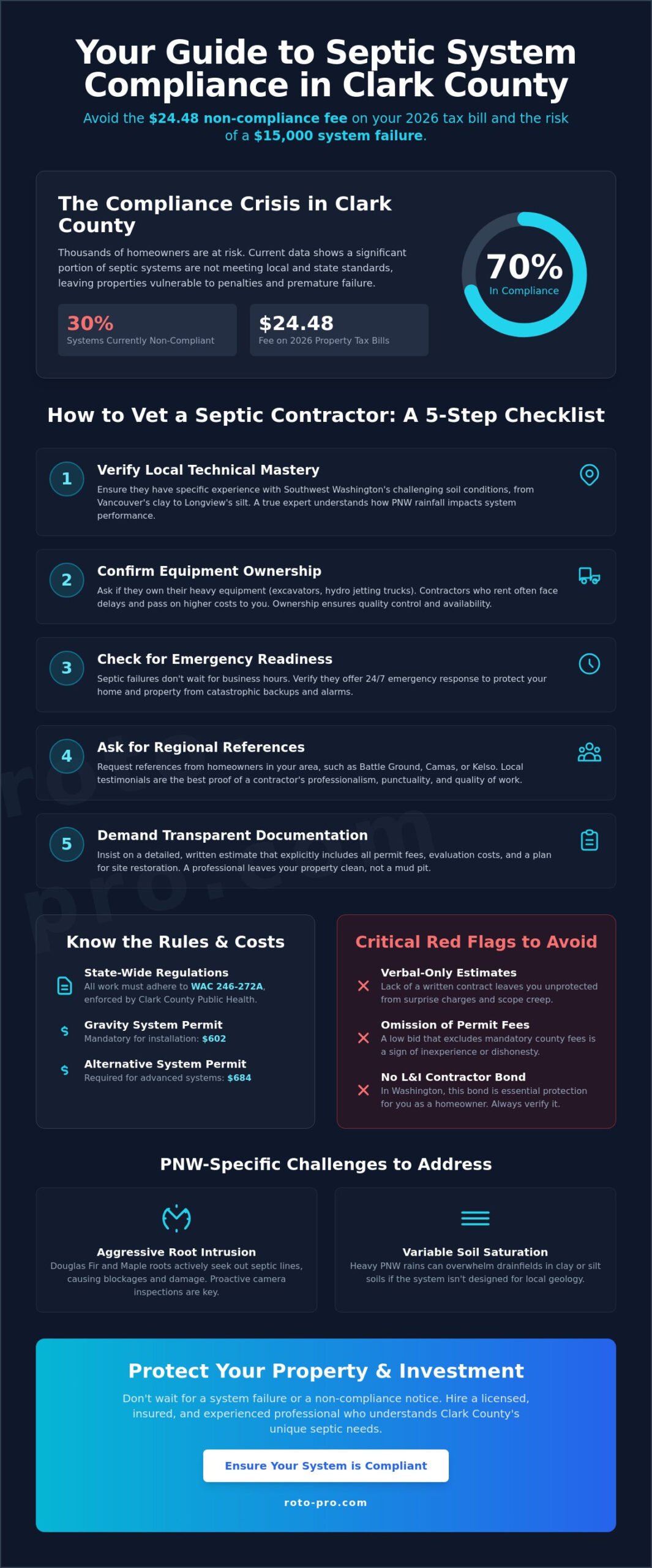
How to Vet a Septic Contractor: A 5-Step Checklist
Vetting a septic contractor requires looking beyond a basic license. You need a partner who understands the technical nuances of Southwest Washington’s geography. Follow this precise checklist to ensure your property remains in expert hands:
- Local Technical Mastery: Verify their specific experience with various types of septic systems. A professional familiar with Clark County soil will know exactly how a system should perform during a November deluge.
- Equipment Ownership: Always ask if they own their excavators and jetting trucks. Contractors who rent machinery often face scheduling delays and higher costs that eventually get passed to the homeowner.
- Emergency Readiness: Septic alarms and backups don’t follow a standard schedule. Confirm they provide 24/7 response to stabilize your home during a mechanical crisis.
- Regional Provenance: Ask for specific references from Battle Ground, Camas, or Kelso. Local homeowners can best vouch for a professional’s punctuality and cleanliness.
- Transparent Documentation: Demand a written estimate that includes site restoration. You shouldn’t be left with a destroyed landscape after the mechanical work is finished.
Evaluating Equipment and Excavation Capabilities
A professional septic contractor invests in their own fleet to maintain total quality control. Ownership means the tools are always available and properly maintained for precision work. For example, hydro jetting vancouver wa is a non-invasive way to clear impacted lines. This high-pressure water technology removes debris without the need for destructive digging. When paired with standard septic system care and maintenance, these advanced tools extend the life of your drainfield by years.
Root Intrusion and PNW Specific Challenges
Vegetation in Brush Prairie and Kelso presents unique risks. Douglas Fir and Maple roots are remarkably aggressive. They often seek out the nutrient-rich environment inside your pipes. A skilled technician identifies these intrusions early using sewer cameras. If your property has a high water table, they must also understand the specific requirements of a mound system to prevent surface breakouts. If you suspect root damage, we can help you assess your system’s integrity before the next heavy rain cycle begins.
Red Flags and Finalizing Your Septic Service Agreement
Selecting a septic contractor involves more than comparing prices. It’s about securing your property’s long-term health. Avoid any professional who refuses to provide a written quote or lacks a physical business address in Washington. These are signs of unprofessional operations that may disappear if the system fails during the next winter storm. A legitimate business remains transparent about its location and licensing status.
Be cautious of bids that seem unusually low. A professional proposal must account for mandatory Clark County costs, such as the $684 voluntary replacement permit or the $1,505 soil evaluation fee. If these figures are missing, you’ll likely face hidden charges once the work begins. Demand a comprehensive warranty on both parts and labor for any septic repair. The agreement should also explicitly state that the company handles all site restoration and cleanup after the excavation is complete.
What Should Be in Your Septic Contract?
A professional contract protects both parties by removing ambiguity. It should list the exact excavation depth and the specific materials used for the drainfield. Timelines are essential. In regions like Longview and Kelso, where heavy rains can halt work, a clear completion date prevents your yard from remaining an open pit for weeks. Ensure the scope of work includes the final county inspection and the filing of all necessary 2026 compliance paperwork.
The Roto Pro Advantage for Clark County Homeowners
Roto Pro provides a distinct advantage for Clark County homeowners through deep technical expertise. We combine 24/7 emergency support with the stability of a local, family-owned business. Our team offers a “one-stop” solution by merging technical plumbing precision with heavy excavation capabilities. This dual expertise ensures that your project moves from diagnosis to final site restoration without the need for multiple subcontractors. We respect your home and your time, delivering results that meet the highest professional standards and ensure your system remains reliable for years.
Securing Your Home’s Infrastructure for the 2026 Season
Maintaining a reliable septic system in Clark County is no longer just about preventing backups; it’s about protecting your financial investment. With the $24.48 non-compliance fee now appearing on 2026 property tax bills, the margin for error has disappeared. You now have a clear framework to identify a qualified septic contractor by verifying their equipment ownership and their understanding of the April 1, 2025 state-wide rule changes. Choosing a professional who handles both technical plumbing and heavy excavation ensures your property remains code-compliant and structurally sound during the wettest months.
Roto Pro stands ready to secure your home with the precision of a Licensed WA General Contractor. We provide 24/7 emergency septic response and utilize expert hydro jetting and excavation equipment to resolve issues without unnecessary property damage. Our team focuses on long-term stability rather than temporary fixes. Don’t wait for the next heavy rainfall to test your system’s limits. Schedule a Professional Septic Inspection with Roto Pro Today to ensure your system operates at peak efficiency. Your home deserves the peace of mind that only expert, professional care can provide.
Frequently Asked Questions
Is a septic contractor different from a regular plumber?
A septic contractor specializes in the complex external wastewater ecosystem, whereas a standard plumber focuses on indoor fixtures and pressurized water lines. This distinction is vital because septic work requires deep expertise in soil science, heavy excavation, and environmental compliance. Professionals in Clark County must renew their health department certification annually by March 1st to maintain their license to work on these specialized underground systems.
How much does it cost to hire a septic contractor in Vancouver, WA?
Professional fees vary based on the technical complexity of the required service. A basic inspection by a certified professional typically ranges from $99 to $115; however, a full residential septic system replacement in Clark County generally costs between $7,000 and $15,000. These figures reflect the specialized heavy machinery and technical soil evaluations required to ensure your system remains reliable and meets all 2026 safety standards.
Do I need a permit for septic repairs in Clark County?
Permits are mandatory for all structural repairs and system replacements, though routine maintenance like pumping or baffle inspections usually doesn’t require one. As of January 1, 2025, the fee for a voluntary replacement permit is $684. Obtaining these permits ensures that your septic contractor completes the work according to local health department codes, which protects your property value and prevents future legal complications.
Can a septic contractor help with a septic alarm going off in the rain?
Expert technicians provide critical emergency support when septic alarms trigger during heavy Vancouver rainfall. These alerts often signal high water levels in the pump chamber or a mechanical failure caused by saturated drainfields. Prompt professional diagnosis identifies whether the issue is a simple electrical fault or a more serious blockage caused by Douglas Fir root intrusion, preventing a total system backup into your living space.