What if a single $65.00 fee is the only thing standing between your home and a successful connection to the public system? For many homeowners, the side sewer inspection clark county requires feels like a high-stakes hurdle, especially when the System Development Charge for a single-family residence has reached $11,468.00 as of January 1, 2026. It’s natural to feel uneasy about technical CRWWD requirements or the risk of failing an inspection and facing costly delays. You want your property to be compliant, but the jargon surrounding laterals and mains often creates more questions than answers.
We understand that you need a clear path to approval without the stress of unexpected repairs. This guide provides the professional advocacy you need to master the inspection process and avoid the $24.48 non-compliance fees that can impact property tax bills. You’ll gain a firm understanding of where your responsibility ends and the district’s begins, ensuring you find a contractor who handles both the camera work and the structural repairs. We’ll walk through the specific permitting steps and the exact standards inspectors look for before you’re cleared to backfill your trench.
Key Takeaways
- Understand that your side sewer is the critical lateral link between your home and the public main, requiring certification during property transfers or major repairs.
- Avoid common technical failures by ensuring your toning wire uses the correct 12-gauge green insulation and your foundation features accessible two-way cleanouts.
- Learn how a professional side sewer inspection clark county service uses high-definition video recording to meet strict District standards for immediate approval.
- Discover why pre-inspection hydro jetting is the professional standard for clearing debris and providing a clear view of pipe wall integrity for the inspector.
- Master the coordination between technical inspection and structural resolution to ensure your property remains code-compliant without the risk of failed backfill requests.
What is a Side Sewer Inspection in Clark County?
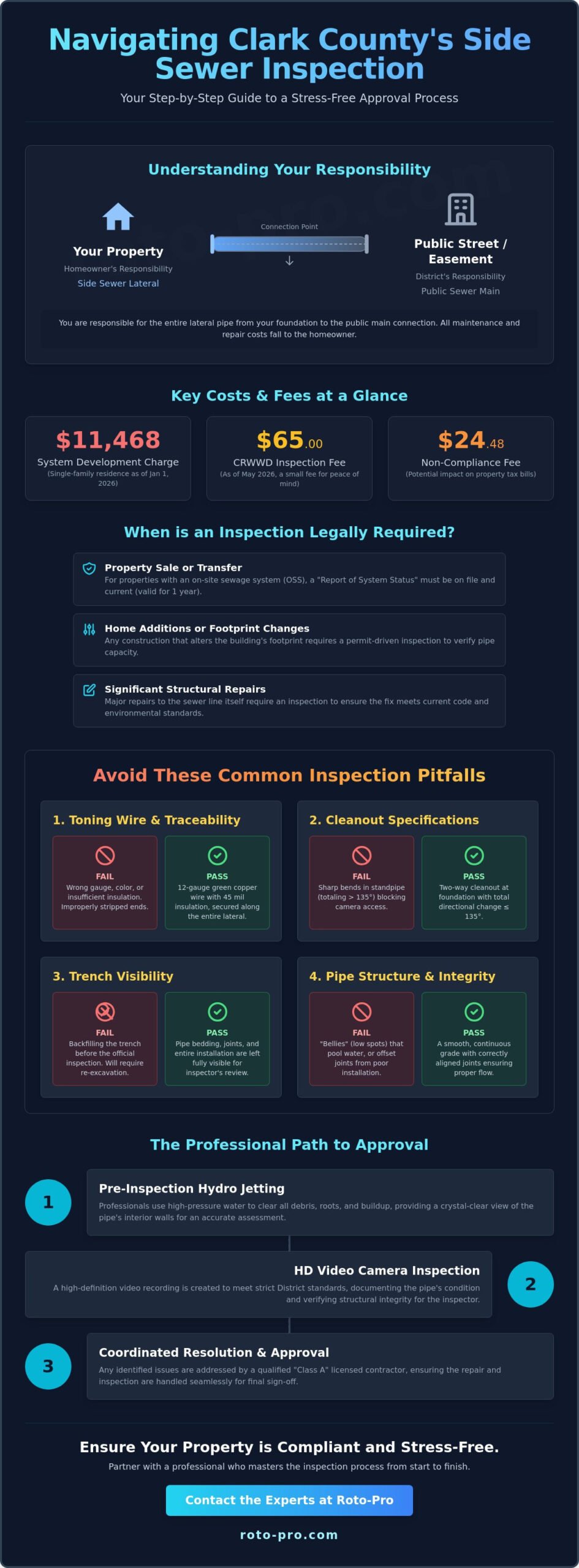
A side sewer is the lateral pipe that carries wastewater from your home’s internal plumbing to the public sanitary sewer system. While the public main is the responsibility of the municipality, the side sewer is private property. In Clark County, your responsibility typically extends from the building foundation to the connection point at the public main, often located in the street or a dedicated easement. A side sewer inspection clark county ensures this private line is free of structural defects, root intrusion, or blockages that could jeopardize the broader infrastructure. Understanding this boundary is vital because the homeowner bears the cost of all repairs on their side of the connection.
When is an Inspection Legally Required?
Specific triggers mandate a formal review of your system’s integrity. For properties utilizing an on-site sewage system (OSS), a “Report of System Status” must be on file with Clark County Public Health when the property is offered for sale. This report remains current for exactly one year from the completion date. Beyond real estate transactions, any home addition or footprint change requires a permit-driven inspection to verify the existing pipe can handle the increased load. A side sewer inspection clark county is also a prerequisite for any significant structural repairs to ensure the solution meets current environmental standards. We also recommend diagnostic inspections for homes experiencing recurring backups to identify if the issue is a simple clog or a structural failure before it becomes an emergency.
The Regulatory Landscape: CRWWD vs. City of Vancouver
Your specific address determines which jurisdiction governs your wastewater. The Clark Regional Wastewater District (CRWWD) oversees much of the unincorporated county and Ridgefield, while the City of Vancouver manages its own utility. Each entity maintains distinct technical codes. For instance, CRWWD assessments require a $65.00 special inspection fee as of May 2026. It’s essential to hire a “Class A” licensed contractor for any work involving public sewer connections. These specialists possess the deep technical knowledge required to meet local standards, which are often more rigorous than general Washington state plumbing regulations. This precision ensures your project meets the exact requirements for final approval and long-term stability.
Common Inspection Failures and How to Avoid Them
Passing a side sewer inspection clark county requires more than just a functional pipe; it demands adherence to specific technical benchmarks. One of the most frequent reasons for a failed permit is the premature backfilling of the trench. Inspectors must see the pipe bedding and joints in their entirety to verify structural integrity. If you cover the line before the official review, you’ll be required to re-excavate at your own expense. Beyond visibility, we often identify structural defects like “bellies,” which are low spots where water pools, or offset joints that occur during installation. These issues must be corrected before the system is finalized to prevent long-term blockages.
The “Toning Wire” and Traceability Requirements
The Clark Regional Wastewater District (CRWWD) mandates the installation of a 12-gauge green copper toning wire with 45 mil insulation along the entire length of the lateral. This isn’t a suggestion; it’s a strict requirement for the official inspection process. Toning wires allow for future utility locating without digging. Common errors include using the wrong wire gauge or failing to strip the insulation properly at termination points, which prevents a clear signal during testing. Ensuring the wire is secured and continuous is a hallmark of a professional installation.
Cleanout Specs: More Than Just a Pipe
Cleanouts serve as the primary access points for maintenance, and their configuration is strictly regulated. Every new or repaired side sewer must feature a two-way cleanout at the building foundation. This allows a technician to send a camera or snake both toward the house and toward the public main. Sharp bends in the standpipe are a common point of failure. Total direction changes in the standpipe cannot exceed 135 degrees because sharp angles block high-definition cameras and cleaning equipment. If a cleanout is located in a driveway or sidewalk, it must be protected by an iron casting frame and cover to prevent structural damage. If your current setup lacks these features, a professional from Roto Pro can bring your property up to code before the inspector arrives.
The Roto Pro Process: From Inspection to Resolution
A successful side sewer inspection clark county requires a combination of high-definition technology and administrative precision. We utilize professional video cameras that provide crystal-clear recordings, which are essential for District review and final approval. Our technicians don’t just run a camera; they document the entire run from the foundation to the main connection. This detailed reporting eliminates ambiguity for the inspector and provides a permanent record of your system’s health. We handle the complex permit scheduling and coordination with local authorities, ensuring your project moves forward without administrative delays.
Hydro Jetting: Preparing Your Lines for the Camera
Before an inspector can certify a pipe, the interior walls must be visible. Accumulated grease, scale, and organic debris often mask structural cracks or minor root intrusions that lead to future failures. Utilizing hydro jetting vancouver wa is the professional standard for preparing a line for high-stakes video review. Our high-pressure equipment is specifically calibrated for the local soil conditions and pipe materials found in Clark County. This thorough cleaning ensures a “clean pass” by removing obstructions that would otherwise trigger a re-inspection fee and delay your project.
Excavation and Repair Expertise
If your inspection reveals a structural “belly” or a collapsed section, the path to compliance requires immediate technical action. We specialize in utility trenching and excavation to access deep sewer lines safely and efficiently. Transitioning from a diagnostic failure to a comprehensive sewer line repair clark county happens seamlessly within our workflow. Every repair we perform adheres to the latest 2026 code updates, ensuring that once the trench is backfilled, your system remains compliant for decades. We take pride in clean worksites and precise technical execution, respecting both your property and the strict standards of the District.
Securing Your Property’s Compliance and Structural Integrity
Achieving a successful side sewer inspection clark county requires a commitment to technical precision that goes beyond simple pipe laying. By ensuring your toning wires and cleanouts meet the exact 2026 District standards, you protect your property from the administrative delays and financial penalties associated with non-compliance. This proactive approach not only facilitates a smooth home sale or renovation but also guarantees the long-term stability of your home’s connection to the public utility. Professional oversight transforms a complex regulatory hurdle into a routine maintenance milestone.
As a Licensed General Contractor in WA, Roto Pro brings deep expertise in hydro jetting and specialized excavation to every project. We understand that sewer issues don’t follow a schedule, which is why we provide 24/7 emergency support for sudden failures. Our team treats your home with the respect it deserves, delivering clean, precise work that satisfies both the inspector and the homeowner. Schedule Your Clark County Side Sewer Inspection with Roto Pro to ensure your infrastructure is handled by expert hands and remains code-compliant for years to come.
Frequently Asked Questions
How much does a side sewer inspection cost in Clark County?
As of May 2026, the Clark Regional Wastewater District (CRWWD) charges a $65.00 fee for a district-authorized or required special side sewer inspection. Homeowners must also account for a $100.00 residential sewer permit fee and a $10.00 electronic locator cap fee. These regulatory costs are separate from the professional labor required for high-definition camera work or pre-inspection cleaning. It’s important to verify current rates with the District before starting your project.
What is the difference between a lateral and a side sewer?
There’s no functional difference between a lateral and a side sewer; both terms describe the private pipe connecting your home to the public main. While “lateral” is a common industry term, “side sewer” is the specific designation used in Clark County regulatory codes and permit applications. Understanding this terminology ensures you’re following the correct local guidelines when discussing repairs or compliance with municipal inspectors.
Do I need to be present for the CRWWD inspection?
You don’t need to be personally present for the inspection if you’ve authorized a licensed contractor to manage the site. The inspector’s primary requirement is unobstructed access to the open trench and the exposed pipe joints before any backfilling occurs. We handle the coordination and technical walkthrough with District officials to ensure all benchmarks are met, allowing you to remain focused on your daily schedule.
Can Roto Pro fix a failed inspection on the same day?
We can often begin resolving issues identified during a side sewer inspection clark county on the same day if the failure involves debris or grease blockages. Our technicians carry specialized equipment to perform immediate hydro jetting or minor adjustments to toning wires. For complex structural failures like collapsed sections or “bellies,” we provide rapid mobilization for excavation and repair to restore your system to code as quickly as possible.
What happens if my toning wire is the wrong color?
If your toning wire isn’t the mandated green color, the inspector will issue an immediate failure for the project. Clark County standards specifically require 12-gauge green copper wire with 45 mil insulation to ensure future utility locating is accurate. If we discover an incorrect wire during our pre-inspection, we’ll replace it with the proper gauge and insulation to prevent a failed permit and the associated re-inspection fees.
How long is a side sewer inspection video valid for a home sale?
A side sewer inspection clark county video and the resulting “Report of System Status” are considered current for exactly one year from the completion date. If you’re selling a property with an on-site septic system, this report must be on file with Clark County Public Health to remain compliant. If your home stays on the market longer than 12 months, a new inspection is required to ensure the data accurately reflects the pipe’s current condition.