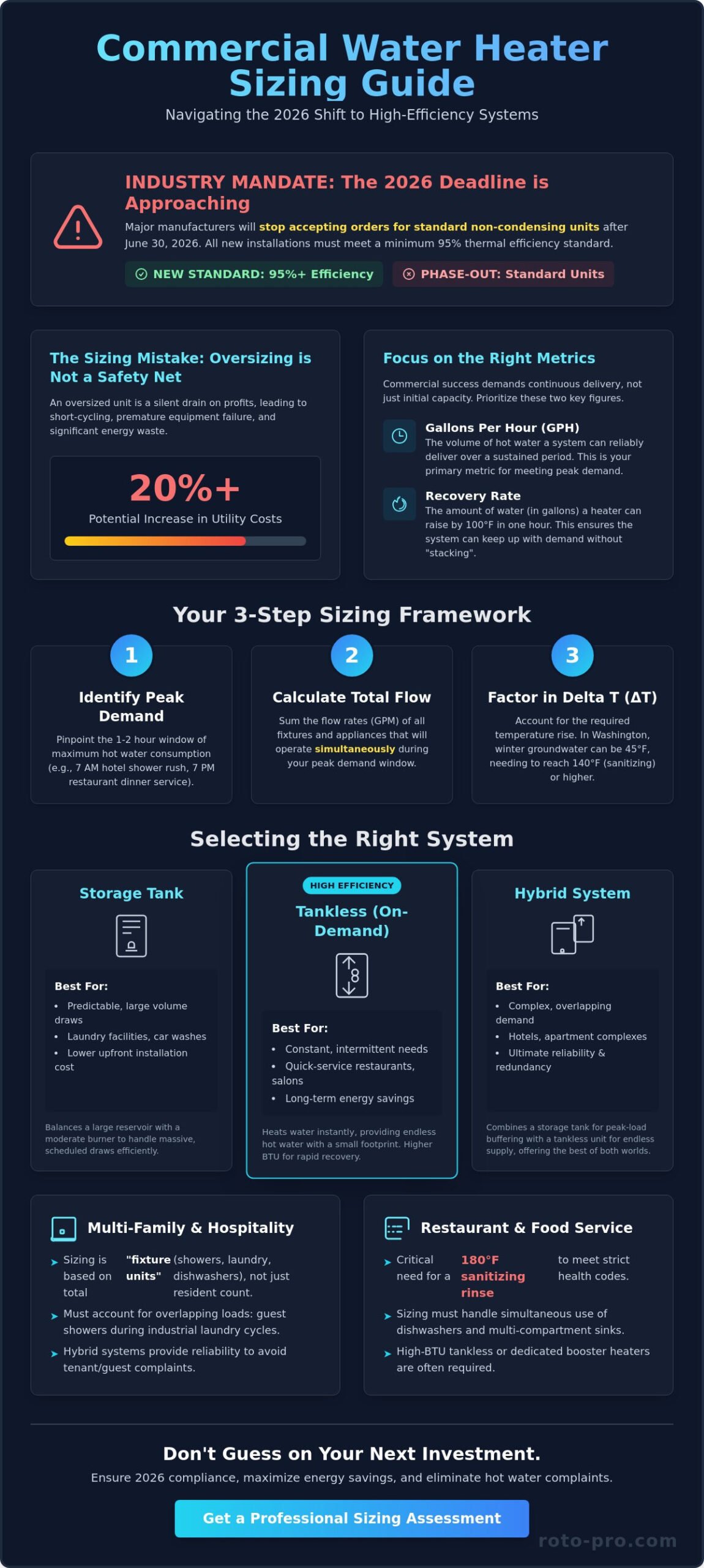
Installing a standard non-condensing unit after June 30, 2026, will soon be impossible as major manufacturers like Rheem stop accepting factory orders for legacy models. For many facility managers, an oversized unit isn’t a safety net. It’s a silent drain on profits that can increase utility costs by 20% or more. This commercial water heater sizing guide helps you navigate these regulatory shifts while solving the fundamental struggle of balancing peak hour demand against long-term energy waste.
It’s frustrating to juggle the technical jargon of Gallons Per Hour (GPH) against storage capacity, especially with price increases of up to 9% hitting the market in early 2026. We’ll provide the exact formulas to calculate your hot water load so you can avoid tenant complaints and stay compliant with Washington State plumbing codes. You’ll learn how the new 95% thermal efficiency standards impact your choice between tank and tankless systems. This framework ensures your next installation is a precise, long-term investment rather than a costly guess.
Key Takeaways
- Understand why Gallons Per Hour (GPH) and Recovery Rate are the essential metrics for ensuring your business never runs out of hot water.
- Learn to identify industry-specific demand profiles to avoid health code violations during high-temperature sanitizing cycles.
- Use this commercial water heater sizing guide to navigate the technical shift toward high-efficiency condensing units required by 2026 standards.
- Evaluate the performance differences between high-capacity storage tanks, tankless racks, and the reliability of hybrid configurations.
- Gain a clear decision framework for selecting a system that balances upfront installation costs with long-term energy savings.
Decoding Commercial Demand: Peak Flow vs. Recovery Rates
Residential plumbing logic often fails in a commercial environment. While homeowners focus on the First Hour Rating (FHR), a business must prioritize Continuous Delivery. The primary metric for success in any commercial water heater sizing guide is Gallons Per Hour (GPH). This figure represents the volume of water the system can reliably deliver at a specific temperature over a sustained period. Relying solely on tank size is a common mistake. A 100-gallon tank with a low BTU burner will eventually run cold during a lunch rush, whereas a smaller tank with high-output heating elements can keep pace indefinitely.
Understanding the recovery rate is essential for system longevity. This is the amount of water a heater can raise by 100°F in exactly one hour. This technical calculation relies on the principles of water heating to ensure the burner or heating element can offset the incoming cold water. If the recovery rate is too low, the system enters a state of “stacking,” where it constantly fires to catch up. This leads to premature tank failure and inconsistent temperatures that can trigger health code violations.
Calculating Your Gallons Per Hour (GPH) Needs
To determine your GPH requirements, you must identify your peak usage windows, such as a 7 AM hotel shower rush or a 7 PM restaurant dinner shift. Peak Demand Period is the specific 1-2 hour window of maximum hot water consumption. In Washington, the intake water temperature often drops to 40°F or 45°F during winter months. This requires a much higher BTU input to reach the 140°F standard required for commercial sanitization compared to warmer climates. You must calculate the total flow rate of every fixture operating simultaneously during that peak window to find your true GPH target.
Storage vs. Heating Power: Finding the Equilibrium
Choosing between high-volume storage and high-power recovery depends on your specific business flow. A laundry facility with predictable, massive draws needs a large storage tank with a moderate burner. Conversely, a quick-service restaurant with constant, intermittent needs benefits from a high-BTU unit with a smaller footprint. Balancing these factors prevents “short-cycling,” which wastes energy and places unnecessary stress on the heat exchanger. Precision here ensures you don’t pay for 500 gallons of storage when a 50-gallon high-recovery unit would perform better.
Industry-Specific Sizing Profiles for Longview, Kelso, and Woodland Businesses
A generic approach to water heating often leads to failure in specialized industries. In the Longview and Kelso area, the local climate forces a significant temperature rise, known as Delta T. Ground water temperatures in this part of Washington can drop below 45°F during winter months. This requires a system capable of heating water by nearly 100°F to reach standard operating temperatures. This commercial water heater sizing guide emphasizes that the needs of a 50-seat bistro in Woodland differ vastly from a 10-unit apartment complex. Precision in these calculations prevents the system from falling below safe temperature thresholds during busy shifts.
Restaurant and Food Service Requirements
Food service establishments in Kelso face strict health department mandates. Commercial dishwashers often require a 180°F sanitizing rinse. This temperature cannot be reached by standard residential-grade units without a dedicated booster heater or a high-output commercial system. You must size your heater based on the peak flow of multi-compartment sinks and high-efficiency dishwashers running simultaneously. Maintaining a high-performing system involves more than just the heater. Regular hydro jetting vancouver wa helps prevent grease buildup in drainage lines, ensuring that your high-volume hot water discharge doesn’t lead to backups.
Multi-Family Housing and Hospitality Sizing
Multi-family housing in Longview presents a different challenge. Sizing depends on the total “fixture units” rather than just the number of residents. This includes accounting for laundry facilities and shared dishwashers. According to the U.S. Department of Energy’s framework for Sizing a New Water Heater, you must calculate the peak hour demand by totaling the expected use of all appliances during the busiest time of day. For hospitality clients, this means balancing guest shower comfort with the massive hot water requirements of industrial laundry cycles. Failure to account for these overlapping loads leads to tenant complaints and increased wear on the unit. If you’re unsure how many fixture units your building requires, consulting with a specialist at Roto Pro can help identify the precise capacity needed for your facility.
Selecting the Right System: Tank, Tankless, or Hybrid?
Choosing the correct equipment architecture is the final step in this commercial water heater sizing guide. High-efficiency gas storage tanks remain the standard for facilities in Longview with massive, simultaneous draws. Conversely, commercial-grade tankless racks offer a modular solution that saves floor space and eliminates standby heat loss for smaller retail footprints in Woodland. A hybrid approach often provides the most stability; it combines a small storage buffer with high-output tankless units to manage sudden spikes in demand without the temperature fluctuations common in older systems.
Installation logistics require precise technical planning. High-BTU commercial units in Kelso often demand larger gas lines and specialized venting materials to handle acidic condensate from condensing heat exchangers. Adhering to ASHRAE standards during the design phase ensures that the system meets the specific recovery and peak flow requirements of your building. Because these systems are complex, professional water heater installation vancouver wa is essential for protecting your factory warranty and ensuring code compliance across Cowlitz County.
The ROI of High-Efficiency Commercial Systems
Investing in Energy Star rated equipment significantly reduces operational overhead for businesses in the Longview area. High-efficiency condensing units can reach up to 98% thermal efficiency. While the upfront cost is higher, the long-term fuel savings often offset the initial investment within a few years. Maintenance is the variable that determines your true ROI. Commercial units fail faster without annual descaling; mineral deposits insulate the heat exchanger and force the system to run longer, which shortens its lifespan.
Compliance and Local Codes in Cowlitz County
Washington State energy codes have become increasingly stringent regarding commercial water heating equipment. Installations in Woodland and Kelso must feature expansion tanks to mitigate pressure spikes and thermostatic mixing valves to ensure safety at the fixture. These components aren’t optional; they’re required for a passed inspection and safe operation. If you’re ready to upgrade your facility’s capacity, Contact Roto Pro for a professional commercial sizing consultation. to ensure your new system is perfectly calibrated for your needs.
Securing Reliability with Technical Precision
Mastering the technical balance between GPH recovery and storage volume is the only way to protect your business from peak-hour failures and high utility costs. This commercial water heater sizing guide provides the necessary framework for navigating the 2026 efficiency standards and local plumbing codes. Proper sizing doesn’t just prevent cold water complaints; it extends the service life of your equipment by reducing mechanical stress and short-cycling. Every gallon of demand must be accounted for to ensure your facility remains compliant and efficient.
As a licensed General Contractor in WA, Roto Pro brings specialized expertise to every project, from internal system calibration to heavy exterior utility work. We provide 24/7 emergency commercial support because we know that a loss of hot water can stop your business in its tracks. Our team focuses on factory-quality results and long-term stability rather than temporary fixes. Schedule a Professional Commercial Sizing Audit with Roto Pro to verify your peak demand requirements before your next system upgrade. Your business deserves a hot water system that delivers consistent performance under any load.
Frequently Asked Questions
Can I use multiple residential water heaters for a small commercial space?
Using residential units in a commercial setting is a technical mistake that usually voids the manufacturer’s warranty and violates local plumbing codes. Residential heaters aren’t engineered for the high-frequency duty cycles of a business or the 180°F temperatures often required by health departments. A proper commercial water heater sizing guide emphasizes equipment rated for continuous delivery to ensure long-term stability and compliance with Washington safety standards.
What is the average lifespan of a commercial water heater in Washington?
The average lifespan for a commercial unit in Washington typically ranges from 8 to 12 years. This duration depends heavily on local water mineral content and the frequency of professional descaling. In the Pacific Northwest, units often work harder to heat colder intake water, which can accelerate thermal stress on the heat exchanger. Regular maintenance is the primary factor in reaching the 12-year estimate while maintaining peak thermal efficiency.
How does the ‘delta T’ affect water heater sizing in the Pacific Northwest?
Delta T represents the temperature rise required, which is significantly higher in the Pacific Northwest due to cold groundwater. During winter months, intake water in Washington can drop to 40°F. If your business requires 140°F water, the unit must provide a 100°F rise. This high Delta T means your system requires more BTU power than a business in a warmer climate to maintain the same Gallons Per Hour (GPH) flow rate.
Do I need a storage tank if I install a commercial tankless system?
A storage tank is often necessary for commercial tankless systems if your facility experiences sudden, massive spikes in hot water demand. While tankless units provide endless water, they have a fixed maximum flow rate. A small buffer tank, often called a hybrid setup, prevents the “cold water sandwich” effect. This configuration ensures that every fixture receives immediate, consistent heat during the busiest 15-minute windows of your daily operation.