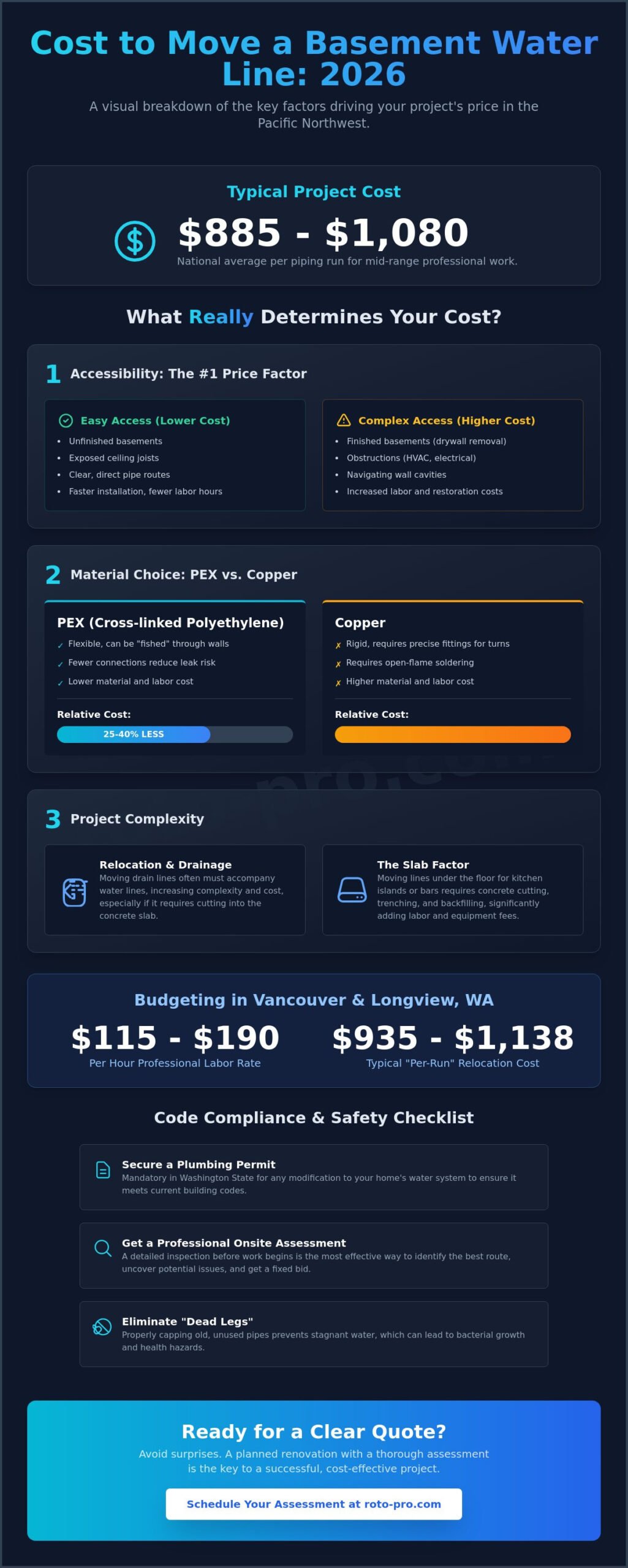
The layout of your basement floor joists often dictates your project price more than the actual length of the pipe. When calculating the cost to move a water line in basement projects for 2026, you’ll find that national averages range from $885 to $1,080 per piping run for mid-range professional work. It’s stressful to look at a concrete wall or finished ceiling and wonder what hidden obstacles will drive up your plumbing invoice. You deserve a clear picture of your investment before the first wall is opened.
You want a home layout that works, but you don’t want to be surprised by hidden labor fees or complex Washington state permit requirements. This guide provides a clear, data-driven breakdown of what you’ll pay for labor and materials this year. We explain the pricing differences between PEX and copper, why accessibility is your biggest cost factor, and the specific Clark County permit fees you must budget for to ensure code compliance.
Key Takeaways
- Understand how accessibility and routing complexity define the true cost to move a water line in basement projects for 2026.
- Identify the technical differences between PEX and copper piping to choose the most reliable solution for your specific basement layout.
- Prepare a precise budget using current labor rates and standard pricing models common in the Vancouver and Longview areas.
- Navigate the essential permitting process in Washington State to ensure your plumbing relocation is fully code-compliant.
- Learn to identify and eliminate “dead legs” to prevent stagnant water issues and maintain the long-term safety of your home’s water system.
What Influences the Cost to Move a Water Line in a Basement?
Moving a pipe isn’t just about the physical length of the tubing. The distance from your main shut-off valve and existing riser locations dictates the path a professional must take. If the new location is far from the main stack, labor hours increase significantly. Most homeowners find that the cost to move a water line in basement renovations also depends on whether a drain line must follow. Since water supply and waste removal work together, relocating a fixture often requires cutting into the concrete slab to adjust the drainage slope, which adds technical complexity to the project.
The condition of your basement walls and ceilings also plays a vital role. An unfinished space with open joists allows for rapid, precise installation. If your basement is already finished, we must factor in the time required to carefully remove drywall and the subsequent costs for professional restoration. We prioritize a clean workspace, but accessing hidden pipes always requires more labor than working with exposed systems.
Material Choices: Copper vs. PEX in 2026
Modern Plumbing systems rely on two primary materials: copper and PEX. Copper remains a gold standard for long-term durability, but it requires open-flame soldering and rigid routing. This increases labor costs because every turn requires a specific fitting. PEX is flexible and can be “fished” through tight spaces with fewer connections, which reduces the risk of future leaks. In 2026, installing PEX typically costs 25% to 40% less than a comparable copper run due to significantly reduced labor time and lower material prices.
Accessibility and Obstructions
Your home’s structural layout is the ultimate price factor. Plumbers often encounter “traffic jams” behind your walls where HVAC ductwork or electrical runs block the most direct path. These obstructions force us to take a longer, more circuitous route to stay compliant with building codes. This added complexity is why the cost to move a water line in basement settings fluctuates based on your home’s unique framing. Running lines through open ceiling joists is always more cost-effective than navigating narrow wall cavities or bypassing heavy structural beams.
Estimating Your 2026 Basement Plumbing Budget
Pricing in the Pacific Northwest reflects the high standard of licensure and technical precision required for modern homes. In the Vancouver and Longview areas, professional labor rates for 2026 typically range between $115 and $190 per hour for scheduled remodel work. Most contractors apply a “per-run” model for standard relocations, which usually falls between $935 and $1,138 according to the latest Cost to Move Plumbing data. However, the total cost to move a water line in basement spaces can increase if you’re dealing with aged infrastructure. If your existing pipes show signs of scale or corrosion, it’s often more logical to invest in a whole house repipe rather than paying for isolated repairs on a failing system.
Scheduling your project in advance is the most effective way to control costs. While emergency response is available for burst pipes, a planned renovation allows for a thorough site assessment and a fixed bid. A detailed onsite inspection helps identify the most cost-effective path before you begin demolition.
Relocation vs. Extension: Knowing the Difference
Physically “moving” an old pipe is rarely the most efficient choice. We often find that capping the old line at its source and running a fresh, continuous line to the new location is more reliable. Branch lines that supply a single sink are relatively straightforward to extend. Rerouting a main trunk line is a more complex operation. These larger pipes carry the volume for your entire home and require specialized fittings to maintain consistent water pressure throughout the system.
The Slab Factor: Cutting into Concrete
When a design requires a kitchen island or a basement bar away from the perimeter walls, the water line must go under the floor. This process involves diamond-blade concrete cutting, manual trenching, and careful backfilling to ensure structural integrity. We utilize professional excavation services in Vancouver, WA for these major utility moves. This under-slab work adds significant labor and equipment fees to the cost to move a water line in basement projects, often requiring a full day of preparation before the first pipe is laid.
Ensuring Code Compliance and Safety in Clark County
Relocating potable water lines in Washington requires strict adherence to the current state building code. You must secure a plumbing permit for any modification to your home’s water system, regardless of the project’s size. In Clark County, this oversight ensures that your new layout meets health standards and prevents cross-contamination. While DIY solutions might seem to lower the cost to move a water line in basement, unpermitted work often leads to expensive corrections during a home inspection. We perform rigorous pressure testing before any walls are closed. This step is the only way to guarantee your basement remains dry and safe from catastrophic floods.
One of the most overlooked risks in basement plumbing is the creation of “dead legs.” These are sections of pipe that have been capped off but remain connected to the main line. Because water doesn’t flow through these segments, it becomes stagnant. Stagnant water is a breeding ground for harmful bacteria that can eventually contaminate your entire home’s supply. We eliminate these risks by removing old piping back to the active branch. If an unexpected issue arises during your renovation, having access to an emergency plumber in Vancouver, WA provides the 24/7 security you need to protect your property.
Permitting and Inspections in Vancouver & Longview
Navigating the local bureaucracy is a standard part of our professional process. For residents within Vancouver city limits, permits are submitted through the ePlans system. You’ll typically face a $32.00 issuance fee and a $6.50 state building fee for residential permits as of May 2026. The inspection process involves a rough-in check while the pipes are still exposed and a final inspection once the fixtures are installed. These steps act as a third-party guarantee that your home remains safe and marketable.
Why a Licensed General Contractor Matters
Basement plumbing often intersects with structural components. Moving a line might require drilling through load-bearing studs or navigating complex joist systems. A licensed professional understands how to maintain your home’s structural integrity while optimizing the cost to move a water line in basement. We combine technical plumbing knowledge with heavy site work expertise to ensure your renovation is built to last. This precision protects your long-term comfort and your home’s equity.
Secure Your Home’s Future with Professional Plumbing
Navigating a basement renovation requires more than just a layout change. It demands a technical understanding of material durability and local code compliance. You’ve seen how factors like slab cutting and the choice between PEX and copper define your project’s scope. Managing the cost to move a water line in basement projects effectively means prioritizing long-term stability over a quick fix. By securing the proper Clark County permits and eliminating risks like stagnant “dead legs”, you protect both your family’s health and your property’s market value.
As a licensed General Contractor in Washington, Roto Pro brings specialized expertise in complex excavation and whole home repiping to every project. We don’t just move pipes; we ensure your entire system operates at peak efficiency with 24/7 emergency support for your peace of mind. Our team respects your home and your timeline, delivering clean, precise results that meet the highest professional standards.
Get a Professional Quote from Roto Pro Today and take the first step toward a functional, code-compliant basement. Your home is your most significant investment, and we’re here to ensure it remains in expert hands.
Frequently Asked Questions
Do I need a permit to move a water line in my basement in Washington?
Yes, Washington State law requires a plumbing permit for relocating any potable water lines. In Clark County and Vancouver, you must obtain a permit for any work on a building’s plumbing system regardless of the project’s total value. This requirement ensures that the modification complies with current safety codes and protects your home’s structural integrity and water quality.
How long does it take a professional to move a basement water line?
A professional plumber can typically complete a standard water line relocation within 4 to 8 hours. If the project involves cutting into a concrete slab or navigating through complex structural obstructions, the timeline may extend to two full days. This duration includes the essential time required for professional pressure testing and job site cleanup before any wall restoration begins.
Can I move a water line myself using PEX?
While PEX is more flexible than copper, a DIY approach is often illegal for permitted work in Washington. Most local jurisdictions require a licensed professional to pull the necessary permits and perform the installation to ensure code compliance. Improperly installed lines can lead to hidden leaks or stagnant water zones that compromise your home’s safety and future resale value.
What is the average cost to move a water line 10 feet in a basement?
The estimated cost to move a water line in basement projects for a standard 10-foot run ranges from $885 to $1,080 as of May 2026. This pricing covers professional labor and materials for a basic, accessible installation. Your final quote may increase if the plumber must navigate through finished drywall or perform specialized excavation to route the pipe under a concrete floor.