Imagine waking up to a persistent alarm during a heavy Clark County downpour while a faint, sulfurous odor begins to drift across your backyard. It’s a stressful moment that often leads homeowners to fear the worst, especially with the thought of invasive excavation or a total system failure. You aren’t alone in this concern. With over 10% of septic systems nationwide estimated to be failing, maintaining your home’s infrastructure requires both vigilance and technical precision.
We understand that a functional waste system is the foundation of home comfort and long-term security. This guide provides the technical clarity you need for effective septic drain field troubleshooting camas wa, helping you distinguish between a simple pipe blockage and a more complex failure of the soil’s absorption capacity. We will examine the unique requirements of local STEP systems, the impact of the April 2025 Washington State rule updates, and the specific diagnostic steps required to restore proper flow to your property while avoiding unnecessary guesswork. You’ll learn how to identify specific failure points and understand when professional sewer line repair or hydro jetting is the most sustainable path forward.
Key Takeaways
- Identify early indicators of drainage failure, such as localized soil saturation and the presence of hydrogen sulfide odors in the yard.
- Distinguish between homeowner responsibilities and City of Camas maintenance duties for properties utilizing STEP or STEF systems.
- Implement a structured approach to septic drain field troubleshooting camas wa by inspecting baffles, filters, and distribution box alignment.
- Evaluate the impact of bio-mat accumulation on soil permeability and learn how hydro jetting offers a non-invasive alternative to total line replacement.
- Understand how recent Washington state regulatory updates and Clark County permitting fees influence the scope and cost of necessary system repairs.
Recognizing the Signs: Is Your Camas Drain Field Failing?
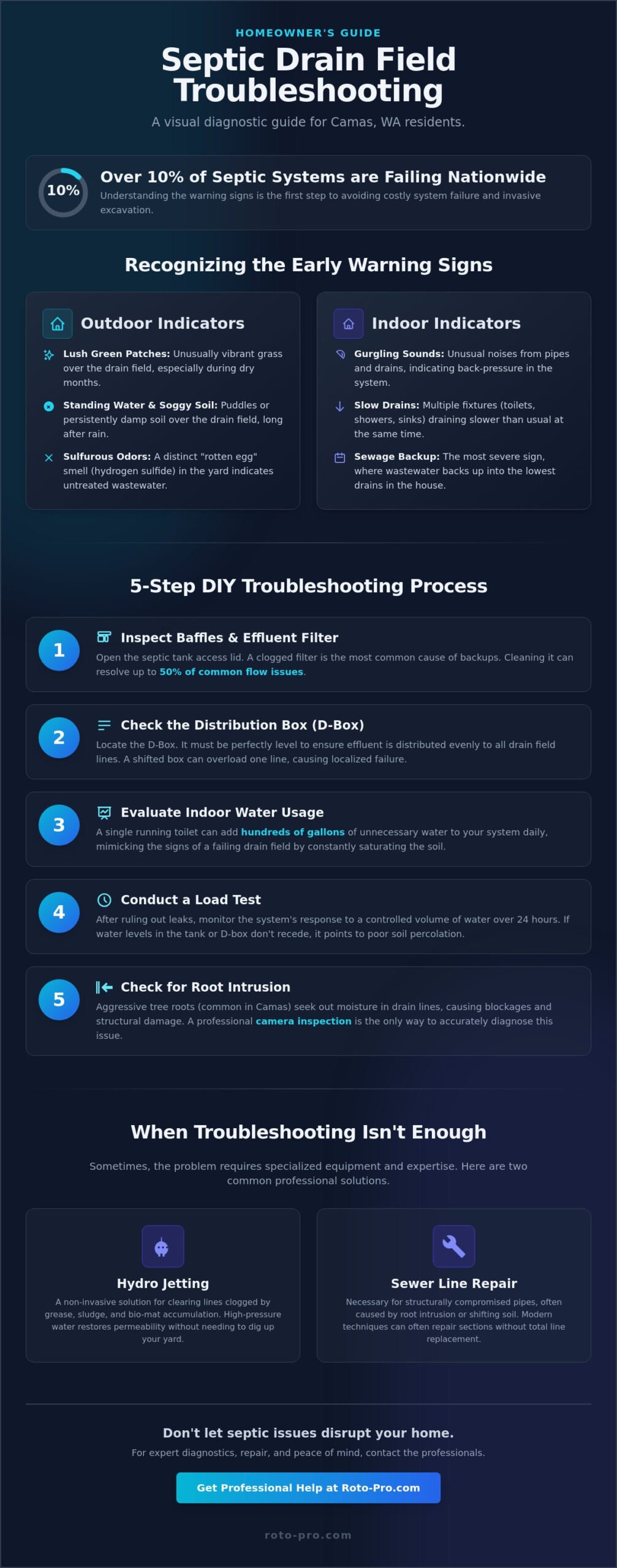
Recognizing a failing drain field requires careful observation of both your landscape and your home’s internal plumbing. Identifying these markers early is the foundation of effective septic drain field troubleshooting camas wa. You might first notice patches of unusually lush, green grass during the dry months, or standing water that persists long after a storm has passed. These surface indicators suggest that effluent is no longer percolating through the soil as intended. When the soil becomes clogged or oversaturated, it forces untreated wastewater to the surface, often accompanied by the distinct, sulfurous odor of hydrogen sulfide.
Indoor symptoms provide additional diagnostic data. If you hear gurgling sounds from your pipes or notice multiple drains running slowly, the issue likely extends beyond a simple localized clog. These signs often point to a back-pressure problem within the main line or the drain field itself. In Clark County, distinguishing between a mechanical failure and seasonal hydraulic overload is vital. Our heavy winter rains can saturate the ground to the point where even a healthy system struggles to process daily water loads.
Private Gravity Systems vs. Camas STEP Systems
Camas homeowners must identify their specific system type before taking action. Traditional gravity systems rely on natural slopes and soil absorption. Conversely, many developments in Camas use Septic Tank Effluent Pumping (STEP) systems connected to the municipal sewer. If your control panel displays a red light or emits an audible alarm, it indicates a pump or high-water malfunction. While you’re responsible for the pipe from the house to the tank, the City of Camas typically maintains the tank and pump components. It’s best to contact the City of Camas Operations Center if you suspect a STEP system failure before attempting DIY repairs.
The Role of Soil Saturation in the Pacific Northwest
The “perc” rate of local soil, which measures how quickly liquid drains, drops significantly during the saturated winter months. This can lead to hydraulic overload; this is a state where the drain field is physically intact but is temporarily overwhelmed by groundwater. Understanding this distinction can save you from unnecessary stress, as the solution may involve temporary water conservation rather than immediate sewer line repair or major excavation.
5 Steps to Troubleshoot Your Septic Drain Field Issues
Systematic diagnostic procedures are essential for accurate septic drain field troubleshooting camas wa. To begin, open the septic tank access lids to inspect the baffles and the effluent filter. A clogged filter is a frequent culprit for backups; cleaning it can resolve up to 50% of common flow issues. Once the filter is cleared, locate the distribution box (D-box). This component must be level to ensure effluent is divided equally among the lateral lines. If one side of your yard is significantly wetter than the rest, the D-box may have shifted, causing a single line to become hydraulically overwhelmed.
The third step involves evaluating indoor water usage. A single running toilet or a leaking faucet can introduce hundreds of gallons of unnecessary water into the system daily. This often mimics the common signs of a failing septic system by keeping the soil in a constant state of saturation. After ruling out internal leaks, conduct a load test. Monitor the drain field’s response to a controlled volume of water over a 24 hour period. If the water levels in the tank or D-box fail to recede, the soil may have lost its ability to percolate.
Managing Root Intrusion from Local Vegetation
Camas is defined by its dense canopy of Douglas Fir and Bigleaf Maple trees. These species possess aggressive root systems that are naturally drawn to the moisture and nutrients inside your drainage pipes. Roots often breach lateral lines through small joints or hairline cracks, eventually creating a total blockage. A professional camera inspection is the most precise way to pinpoint these intrusions. If roots have structurally compromised your pipes, seeking expert sewer line repair in Clark County is a necessary step to prevent a complete field collapse.
Mechanical Checks for Pump-to-Gravity Systems
If your property requires an uphill lift to reach the drain field, you likely have a pump-to-gravity setup. Test the float switches manually to ensure they move freely and trigger the pump as intended. Debris can sometimes pin a float in the “off” position, leading to a high water alarm. If the pump is operational but the field remains saturated, professional main line repair or hydro jetting may be required to clear accumulated sludge from the transport pipe.
Restoration and Repair: When Troubleshooting Isn’t Enough
If initial diagnostics don’t restore flow, the issue likely resides in the soil interface. Over time, a “bio-mat” layer of anaerobic bacteria and organic solids forms at the bottom of the lateral trenches. While a thin bio-mat is necessary for filtering, excessive buildup seals the soil too tightly, preventing effluent from draining. This biological seal is a primary cause of system failure in older Camas properties. Understanding these Signs of Septic System Failure helps determine if your system requires advanced restoration or a full component replacement.
A comprehensive approach to septic drain field troubleshooting camas wa often reveals that mechanical restoration is more cost-effective than full system replacement. Restoring soil porosity may involve soil fracturing, also known as air injection, which breaks up the compacted earth around the drain lines. Adhering to these regulations is critical, as all repairs must comply with Clark County Public Health standards. As of January 1, 2025, the official fee for a “Repair of Failure” permit for systems under 1,000 gallons per day is $479. These local requirements are strictly enforced following the April 1, 2025, updates to Washington state’s wastewater rules.
Why Hydro Jetting is the Best First Choice for Drain Fields
Hydro jetting utilizes high-pressure water streams to scrub the interior of lateral lines and break apart the bio-mat layer. It’s a non-invasive procedure that avoids the heavy equipment and landscape disruption associated with traditional excavation. When compared to the high cost of a new septic installation, which can exceed $15,000 in Washington, routine maintenance jetting is a financially prudent alternative. This process effectively clears sludge and biological buildup that standard snaking cannot reach. For a deeper look at the technology, read our complete guide to hydro jetting in Vancouver, WA.
When Excavation is Unavoidable
Physical replacement becomes necessary when lateral lines have collapsed or were structurally compromised by root intrusion. In these instances, a professional assessment will identify the need for trenching and pipe installation. We approach site work with precision, focusing on utility trenching that minimizes damage to your Camas landscape. It’s essential to employ a licensed general contractor for this work to ensure all repairs meet the mandatory standards required for the upcoming February 1, 2027, property transfer inspections. If your system has reached the end of its functional life, a professional sewer line repair or replacement is the only way to guarantee long-term home comfort.
Securing Long-Term Infrastructure for Your Camas Home
Maintaining a healthy septic system in the Pacific Northwest requires a balance of technical knowledge and timely action. Differentiating between municipal STEP systems and private gravity setups helps you avoid unnecessary costs and stay compliant with the latest 2025 Washington state standards. Effective septic drain field troubleshooting camas wa starts with recognizing early saturation signs before they escalate into a total system failure. Whether the solution involves clearing a simple filter clog or addressing complex bio-mat accumulation, a structured diagnostic approach is the most reliable way to protect your home’s comfort and value.
When internal diagnostics aren’t enough, professional intervention provides the precision needed for a permanent resolution. Roto Pro is a Licensed General Contractor in WA specializing in advanced hydro jetting and strategic excavation to restore drain field integrity. We provide 24/7 emergency response to address alarms or backups immediately, ensuring your household operations return to normal. Contact Roto Pro for Expert Septic Troubleshooting in Camas to secure your home’s infrastructure with expert, code-compliant care. Taking these proactive steps today ensures a functional and stable environment for your family.
Frequently Asked Questions
My septic alarm is going off in Camas—what should I do first?
Silence the alarm and determine if your property utilizes a City of Camas STEP system. If you’re connected to the municipal STEP network, an alarm usually indicates a high-water condition or a pump malfunction that the City Operations Center should address. For those on private gravity systems, a triggered alarm typically signals a failure in the pump chamber or a severely clogged effluent filter that requires immediate inspection to prevent an indoor backup.
Can heavy rain cause my drain field to fail temporarily?
Yes, hydraulic overload is common during Clark County’s heavy seasonal rains when the soil reaches its maximum saturation point. When the ground is fully saturated, it loses its ability to absorb additional effluent, leading to temporary ponding over the lateral lines. This is a primary factor in septic drain field troubleshooting camas wa; often, the system will regain functionality once the soil dries, provided you reduce water consumption during the storm.
How do I know if my septic problem is the tank or the drain field?
Inspect the water level inside the septic tank relative to the outlet pipe. If the water level sits above the outlet and the effluent filter is clear, the blockage is located downstream in the drain field or the distribution box. If the tank levels are normal but your household drains remain slow, the problem is likely a localized clog or a structural issue in the main line between the house and the tank.
Is it safe to use chemical additives to ‘clean’ my drain field?
No, professional standards and Washington state health guidelines generally discourage the use of chemical additives for “fixing” a failing field. These chemicals can disrupt the essential bacterial colonies in your tank or cause solids to break down and migrate into the soil, which seals the drain field pores permanently. Physical restoration methods, such as professional hydro jetting, are the only verified way to remove bio-mat buildup without damaging the ecosystem of your system.
How much does it cost to fix a failing drain field in Camas, WA?
Repair costs depend on the technical scope of the failure and the necessary Clark County permits. As of January 1, 2025, a permit for a “Repair of Failure” for a standard residential system is $479. While non-invasive restoration like hydro jetting is a cost-effective first step, a full system replacement in Washington state can exceed $15,000. Homeowners should always verify current fee schedules with Clark County Public Health before beginning major work.
Will Douglas Fir roots actually destroy my septic pipes?
Yes, the aggressive root systems of native Douglas Fir and Bigleaf Maple trees are a leading cause of structural failure in Camas drainage systems. These roots are naturally drawn to the nutrient-rich moisture inside your pipes and can enter through the smallest joints or hairline fractures. Once inside, the roots expand, eventually causing the pipes to crack or collapse entirely, which necessitates a full sewer line repair or replacement.